














Could This 'Thinking Cap' Help You Learn?
Charlie Heck, multimedia news editor at the U.S. National Science Foundation (NSF), contributed this article to Live Science's Expert Voices: Op-Ed & Insights.
We've heard it more than once in elementary school: "Time to put your thinking caps on." One day, students might just do that. According to Vanderbilt University psychologist Geoffrey Woodman, scientists are now equipped with ever more tools to better understand the brain, and now they can even eavesdrop on individual neurons.
Woodman approached NSF, and with their support, Woodman and his team at the university's Visual Cognitive Neuroscience Laboratory tested their theory that electrical stimulation of the brain's medial-frontal cortex can boost learning and improve decision-making. [Electric Brain Booster (Do Not Try This at Home) (Gallery )]
Below, Woodman provides a Q+A with context for the research.
NSF: What is the medial-frontal cortex and how does this thinking cap affect its function?
Geoffrey Woodman: The cortex is the outer layer of the brain. Cortex is actually short for neocortex, neo meaning new, because this part of the brain appears to be a fairly new product of evolution. Medial refers to the middle part of your head. Frontal refers to the frontal bone of the head. If you put your tongue on the highest point on the roof of your mouth, then straight up from that point is the location that we stimulated with electrical current.
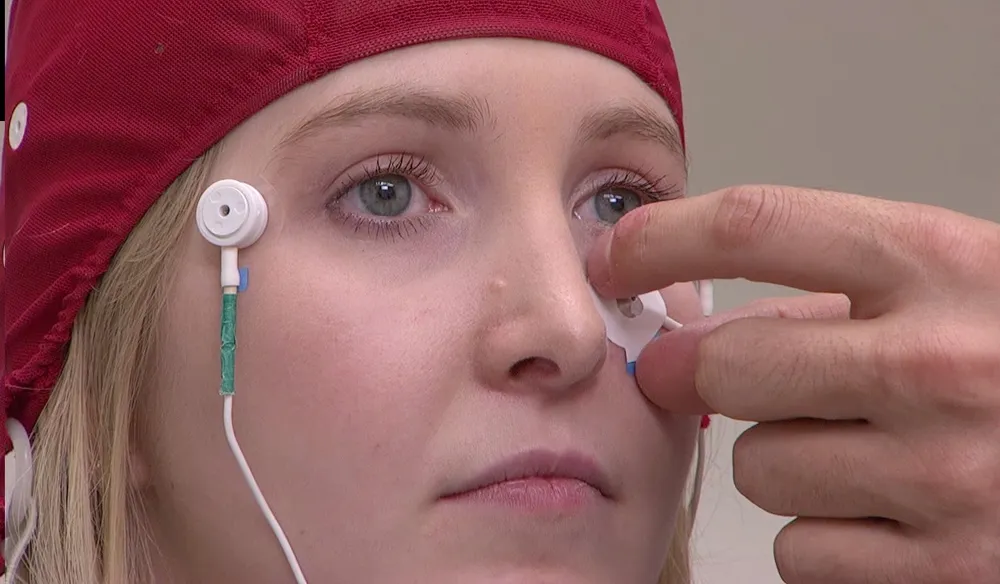
The thinking cap is a simple term for what scientists call transcranial direct-current stimulation. Transcranial simply means that the electrical current goes through the bones of the head (or cranium). Direct current is the type of unchanging, constant current you get from a battery (e.g., a 9-volt). This is in contrast to alternating current that comes out of our wall sockets. We use extremely weak direct current stimulation, putting conductive rubber pads on people's heads and running this extremely weak current through the head and brain for 20 minutes. The current is so weak that it is difficult to tell if the stimulator is even on. [Bilingual People Are Like Brain 'Bodybuilders' ]
Get the world’s most fascinating discoveries delivered straight to your inbox.
Our work shows that we can change the brain activity thought to come from the medial-frontal cortex, and more importantly improve how quickly people can learn basic tasks. Based on fundamental neuroscience, the electrical current of the thinking cap is causing brain cells to fire together in a more coordinated way, and as a result, convey information in the brain more efficiently.
NSF: The brain seems to be the final frontier in all of science. What makes neuroscience so mysterious, fascinating and why do you do it?
G.W.: It is amazing that we know significantly more about how the universe works than how three pounds of flesh functions in our own heads. This is surprising, because this gap is not due to a lack of interest. We all think about how we think. For example, "Why didn't I remember my anniversary?" Part of the gap in our knowledge between the physical and the mental world was due to an old philosophical belief that the mind cannot understand itself. However, for a little more than a century, scientists have been designing clever experiments so that they can test hypotheses about how our minds work. This work has accelerated dramatically as we have combined recordings and manipulations of brain activity with simple laboratory tasks that allow us to isolate specific mental functions. [Who Will Save Earth? The Ingenious Human Mind (Op-Ed )]
NSF: How does short-term versus long-term memory fit into your research?
G.W.: This is an excellent question. Even someone who doesn't know anything about psychology or neuroscience is aware that there are different types of memory storage. I can remember many events from kindergarten through sixth grade, yet when I walk into the kitchen I cannot remember what I was coming to get. People usually find it useful to know that this is normal. Short-term memory — also known as working memory in modern theories — temporarily stores information that we need for a task at hand. Although this type of memory storage is vital throughout our day as we switch from task to task, it is somewhat fragile and does not hold very much. The average healthy young adult can store about three simple objects in short-term memory, and even these healthy young adults lose some of this information if distracted, such as being shown something new, like when we walk into our kitchen. In contrast, long-term memory appears to be essentially unlimited in its capacity, but our failures come from an inability to pull the critical information out of long-term memory when we need it. In many experiments, psychologists and neuroscientists try to isolate one of these types of memory storage to study it.
In our work, we study how short-term memory and long-term memory work together. We use laboratory tasks that ask people to look for a certain object. This task is like looking for your lost keys in your house. We have people look for a specific object in array after array of objects. As you would expect, people get better as this task each time they do it. What our measures of brain activity allow us to do is see how short-term memory and long-term memory simultaneously contribute to the performance of this task. What our studies have been showing is that both of those types of memory storage contribute to how we process information at the same time. Our more recent experiments have looked at how brain stimulation improves task performance and accelerates learning. What our simultaneous measurements of brain activity show is that long-term memory appears to be the source of this accelerated learning, even though it is unfolding across just a matter of seconds to minutes.
NSF: Can you tell us a little bit about the experiments you had the subjects do? Are they learning faster, making fewer mistakes, etc.?
G.W.: We designed a very simple task in which people just had to see an object that could be one of two colors. Once they could tell what color it was, they had to press one of two buttons on a gamepad (it's just like a Sony Playstation controller). The trick was that we didn't tell the people which button to press when they saw each color. They had to figure that out by trial and error. This was made even harder because we gave them only about half a second to press the right button. This allowed us to measure learning during a simple, but demanding task.
We found that the brain stimulation made people more accurate overall. This was not because people responded slower after brain stimulation. Instead, they were just as fast at pressing the buttons, but did so more accurately. This overall effect was partially due to people learning the task faster after receiving brain stimulation. People's behavior and brain activity both indicated that they learned which button to press, given a certain color, more quickly than without brain stimulation.

NSF: How long do these benefits of brain stimulation last?
G.W.: We ran a couple of experiments to determine how long this improved accuracy and learning. We initially hoped that it would last a day or more. However, we found that the effects one day were gone the following day. To determine when the effects disappear, we kept people around the lab for two days, with the second day lasting about eight hours. We collected measurements of baseline activity on the first day. On the next day we stimulated their brains and measured activity for about three hours. After an hour break, we measured their performance and brain activity for another three hours. We found that 20 minutes of brain stimulation resulted in significant influences on behavior and neural activity that lasted up to five hours.
NSF: Can you tell us a little bit about visual search tasks and how it relates to this research?
G.W.: As we discussed briefly before, finding certain objects is something we all do every day of our lives. In the laboratory, we use visual search tasks to study how people attend to objects in a complex scene. People have believed that when you are shopping at the grocery store for a bag of apples, that visual attention becomes focused on the bags of apples because you are holding a representation of a bag of apples in visual working memory. What a number of experiments have shown in our NSF-sponsored research is that learning, and what is stored in long-term memory, actually plays a critical role in controlling attention. This challenges a number of ideas that scientists have had about how attention works. The research with brain stimulation gives us a way to directly control how rapidly we learn, and now we can see if we can more rapidly learn to control attention with information stored in long-term memory.
NSF: Why do you think that stimulation of this part of the brain was effective in showing improvements in the tasks you used?
G.W.: We think the stimulation was effective because this part of the brain is a key intersection in several different brain networks. The medial-frontal cortex is critical for learning, and is connected to virtually every other part of the brain either directly or through another part of the brain. This makes it critical for integrating visual information and mapping that visual input on to specific responses (e.g., the press of a button). This region of the brain has been shown in previous work to be particularly active when we make an error. That is, this part of the brain appears to detect when we have made mistakes. This kind of neural activity is thought to be critical in allowing us to correct our behavior and learn from our mistakes. Thus, by stimulating this area of the brain we were able to boost this function and allow people to learn faster and make fewer mistakes.

NSF: What are some of the real world implications with this type of technology?
G.W.: The research findings of our study join a growing body of work suggesting that noninvasive electrical stimulation may be a cognitive-enhancing technique for people with psychiatric and neurological disorders. There have been a number of promising discoveries using electrical stimulation methods aimed at reducing deficits in patient populations, such as depression, schizophrenia and attention deficit hyperactivity disorder. Electrical stimulation has also proven useful for patients with brain injuries, such as stroke. In addition to drug-free alternative treatment options for patient populations, there has been research showing how brain stimulation can improve functioning in healthy adults across a variety of domains, including language, mathematics, memory, and motor coordination. We are currently working with clinicians to determine whether the type of brain stimulation we used in this study can be used to help people with certain mental disorders. Our preliminary findings are promising. We are hopeful that our basic science will quickly translate into treatments that can help people and have a broad positive impact on society.
NSF: What kind of tasks would likely benefit from the type of stimulation you used in this study?
G.W.: The jury is still out on how broad these effects might be. Clearly, we have seen improvements in learning how to respond to stimuli with complex motor commands. For example, we would predict that people could more quickly learn to control vehicles, type, operate in virtual environments, perhaps acquire fine motor skills, such as required in surgery. Experiments in our laboratory, and other laboratories, are looking at whether we can speed the learning of material more generally. I'm sure all of the undergraduate students would like to know if they could use this type of stimulation and learn their textbook more quickly. These experiments are currently underway. There are reasons to believe that stimulation of the medial-frontal cortex would not be very effective in boosting this type of learning, but we may be able to find a part of the brain that could aid this type of learning, too.
There are no known side effects of the direct-current stimulation used in this thinking cap. However, we want to be cautious about its use. Long-term use studies do not yet exist, and our field still needs to verify that there are not potential risks for people looking to use this technology to boost their learning routinely.
Follow all of the Expert Voices issues and debates — and become part of the discussion — on Facebook, Twitter and Google+. The views expressed are those of the author and do not necessarily reflect the views of the publisher. This version of the article was originally published on Live Science.