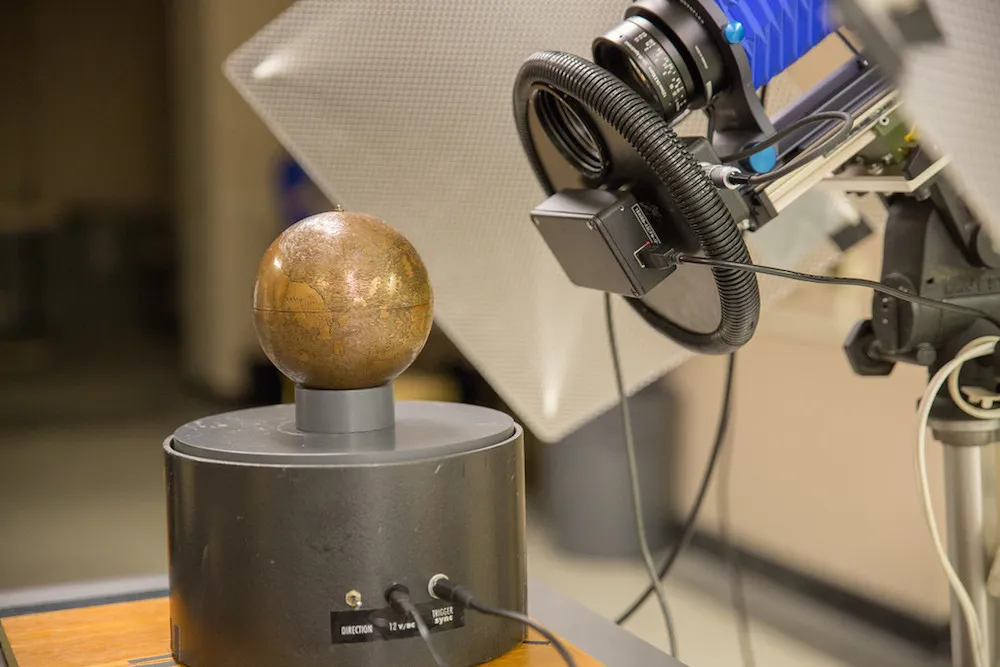
The Lenox Globe, a small copper sphere housed in the New York Public Library, is the oldest known surviving globe that shows the New World. A team of researchers and librarians set out to create a high-resolution, digital reconstruction of the globe, using multispectral imaging and 3D scanning. They hope the digital replica will allow scholars and members of the public to study the artifact and understand its history. [Read full story about the Lenox Globe]
The technique, known as multispectral imaging, captures the object's color most faithfully, and provides a complete record of it, the researchers said. (Image credit: Tanya Lewis)
To capture the globe in digital form, the team used a method that involves imaging the object in a variety of different colors, or wavelengths. (Image credit: Jonathan Blanc/The New York Public Library)
Different colored lights were used to capture the images at different wavelengths, including ultraviolet — which is powerful enough to damage your eyes if you don't shield them, the researchers cautioned. (Image credit: Jonathan Blanc/The New York Public Library)
The imaging was done in conjunction with the Lazarus Project, a nonprofit organization that conducts advanced imaging to preserve the cultural heritage of objects. (Image credit: Jonathan Blanc/The New York Public Library)
Imaging a curved surface isn't easy. You need to have a flat field, otherwise the light reflections will change the color and geometry of the image. (Image credit: Jonathan Blanc/The New York Public Library)
After taking the high-resolution color images, the researchers made 3D scans of the Lenox Globe. By wrapping the 2D multispectral images around the 3D scans, they can get a much more accurate reconstruction of the globe. (Image credit: Jonathan Blanc/The New York Public Library)
Sign up for the Live Science daily newsletter now
Get the world’s most fascinating discoveries delivered straight to your inbox.
Not much was known about the globe until 1850, when an architect named Richard Morris Hunt purchased the globe at a flea market in Paris. Hunt donated the globe to the Lenox library, which is now part of the New York Public Library. (Image credit: Jonathan Blanc/The New York Public Library)
The researchers hope that creating a digital replica of the Lenox Globe will make it accessible to generations of scholars and members of the public. (Image credit: Tanya Lewis)
Tanya was a staff writer for Live Science from 2013 to 2015, covering a wide array of topics, ranging from neuroscience to robotics to strange/cute animals. She received a graduate certificate in science communication from the University of California, Santa Cruz, and a bachelor of science in biomedical engineering from Brown University. She has previously written for Science News, Wired, The Santa Cruz Sentinel, the radio show Big Picture Science and other places. Tanya has lived on a tropical island, witnessed volcanic eruptions and flown in zero gravity (without losing her lunch!). To find out what her latest project is, you can visit her website.