













New 'Super-Repellent' Material Could Protect Medical Implants

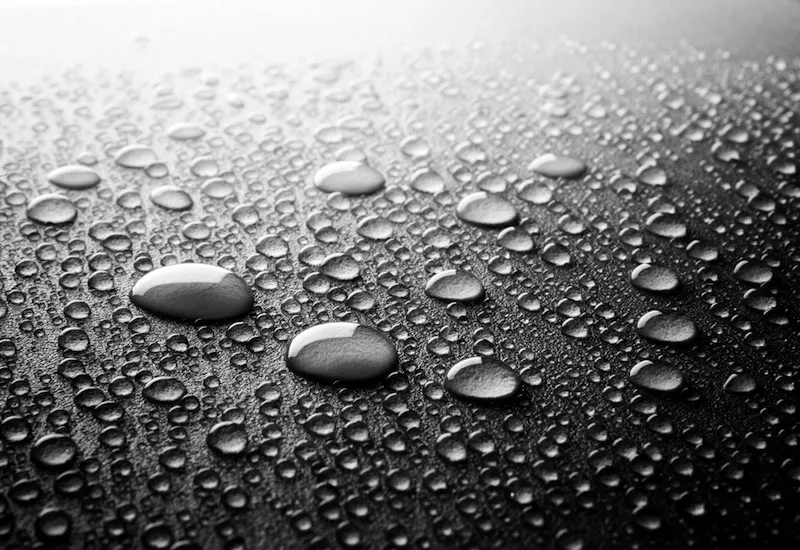
Scientists have created the most non-stick surfaces yet, using microscopic liquid-repellent structures instead of plastic coatings such as Teflon.
These new surfaces could help protect medical implants from gunk that can build up on and ruin the devices, endangering patients, researchers say.
Natural materials such as insect wings and duck feathers are often water-repellent, or hydrophobic. Many other substances are oleophobic, which means they repel oil. [Biomimicry: 7 Clever Technologies Inspired by Nature]
Most liquid-repellent surfaces use plastic coatings. However, these degrade at high temperatures, which limits their use.
Now, scientists have developed a way to render many different materials super-repellent to both water and oil without using coatings. Instead, the roughness of the materials' surface is simply altered to make them "superomniphobic."
Surface tension is the property that makes drops of liquid want to bead up. But, the surface that a liquid rests on can exert attractive forces that cause the liquid to wet or spread across that surface.
In the past 20 years or so, scientists have discovered that super-hydrophobic objects, such as lotus leaves, are often covered in microscopic bumps so that droplets float on top. The first water-resistant materials, developed in the 1960s, similarly took into account surface roughness.
Get the world’s most fascinating discoveries delivered straight to your inbox.
"Usually artificial surfaces repel water because of the chemical composition of the material, but in our case, the repulsion is almost completely by mechanical means," said study co-author Chang-Jin Kim, a mechanical engineer at the University of California, Los Angeles.
The researchers started with silica and etched a "bed of nails" structure onto it, with each nail head measuring 20 microns wide, or about one-fifth the average width of a human hair. They next undercut their nail heads to create overhangs resembling the fringes of beach umbrellas that were 1.5 microns long and three-tenths of a micron thick. Kim first imagined a shape similar to these structure more than 25 years ago, and had been waiting since for micro-machining techniques advanced enough to actually fabricate them.
The scientists found that these newly developed surfaces repelled not just oil and water, but also fluorinated solvents, which are liquids with the lowest surface tension known. These solvents completely wet all other known surfaces, including Teflon. Without a plastic coating, the super-repellent silica could withstand temperatures more than 1,830 degrees Fahrenheit (1,000 degrees Celsius).
The researchers found similar results when they etched these structures onto a metal, tungsten, and a plastic, parylene. "It doesn't matter what kind of material we use — they repel liquids exactly the same way because the repulsion is mechanical in nature, not chemical," Kim told Live Science.
The researchers expect these super-repellent materials to last longer in outdoor environments and industrial settings than traditional super-repellent materials. "This could also have biomedical applications — you won't have unwanted substances building up on surfaces anymore in the body," Kim said.
Although the fabrication methods the researchers used to create these structures for their experiments are quite expensive, Kim said the structures can be mass-produced using simpler and cheaper processes.
Kim and his colleague Tingyi Liu detailed their findings online today (Nov. 27) in the journal Science.
Follow Live Science @livescience, Facebook & Google+. Original article on Live Science.
