













Toxic Toledo Algae Bloom Seen from Space (Photo)

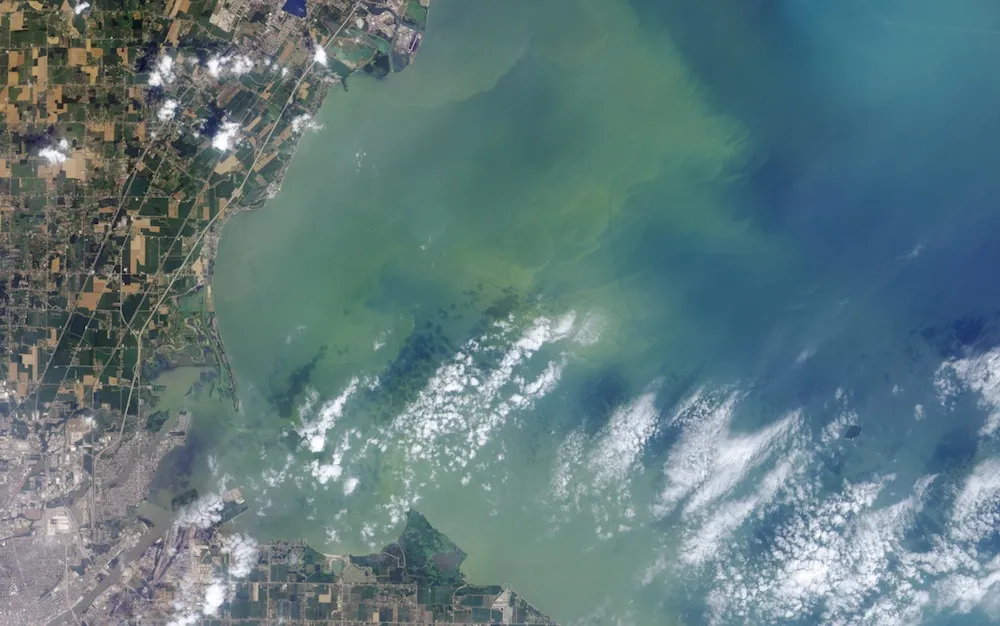
An algae bloom in Lake Erie that left hundreds of thousands of people in Toledo, Ohio, and its surroundings without water for two days is visible in new satellite imagery.
The bloom appears as a cloudy green mass in the blue of Lake Erie. Toledo is in the lower left of the image, along the lake's shore.
The mayor of the city lifted a ban on drinking Toledo's water on Monday (Aug. 4), after two days in which residents were warned that water from the Collins Park water treatment plant was contaminated with a toxin produced by the freshwater algae Microcystis. The treatment plant serves 500,000 customers in Toledo and its suburbs.
If ingested, the Microcystis toxin causes symptoms such as dizziness, vomiting and numbness. Though there are no reports of human deaths from the toxin, it can cause liver damage, according to Californa's Office of Environmental Health Hazard Assessment (OEHHA). Pets and wildlife have died from the toxin, according to OEHHA.
Boiling water does not remove the toxin, so residents found themselves lining up at stores and distribution centers in search of bottled water. Farmers from outside the city pumped well water and brought it into town to give away for free, according to news reports.
Algae blooms are fed by fertilizer runoff, which brings nitrogen and phosphorous into the water.
This image of the toxic bloom was captured by the Landsat 8 satellite on Aug. 1. This satellite's instruments capture wavelengths of light that allow researchers to adjust for atmospheric distortions that occur near coasts, according to NASA's Earth Observatory.
Get the world’s most fascinating discoveries delivered straight to your inbox.
Editor's Note: If you have an amazing nature or general science photo you'd like to share for a possible story or image gallery, please contact managing editor Jeanna Bryner at [email protected].
Follow Stephanie Pappas on Twitter and Google+. Follow us @livescience, Facebook & Google+. Original article on Live Science.

Stephanie Pappas is a contributing writer for Live Science, covering topics ranging from geoscience to archaeology to the human brain and behavior. She was previously a senior writer for Live Science but is now a freelancer based in Denver, Colorado, and regularly contributes to Scientific American and The Monitor, the monthly magazine of the American Psychological Association. Stephanie received a bachelor's degree in psychology from the University of South Carolina and a graduate certificate in science communication from the University of California, Santa Cruz.