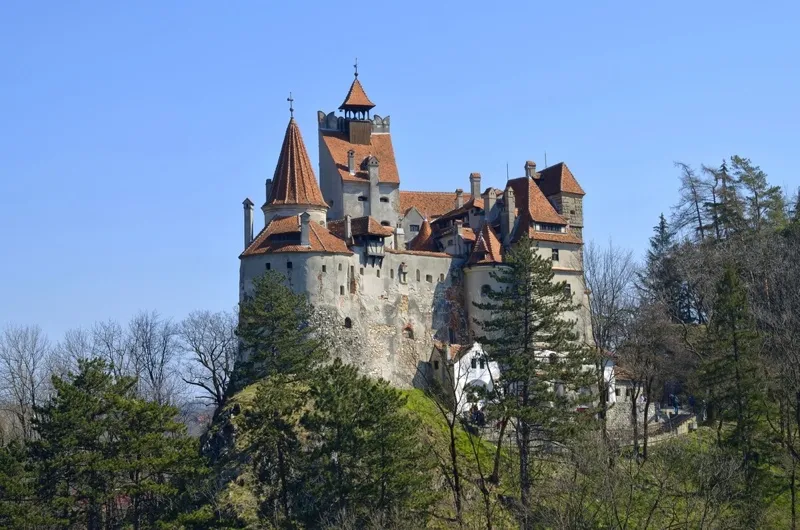
Dracula's Castle Up for Sale
Get the world’s most fascinating discoveries delivered straight to your inbox.
You are now subscribed
Your newsletter sign-up was successful
Want to add more newsletters?
Delivered Daily
Daily Newsletter
Sign up for the latest discoveries, groundbreaking research and fascinating breakthroughs that impact you and the wider world direct to your inbox.
Once a week
Life's Little Mysteries
Feed your curiosity with an exclusive mystery every week, solved with science and delivered direct to your inbox before it's seen anywhere else.
Once a week
How It Works
Sign up to our free science & technology newsletter for your weekly fix of fascinating articles, quick quizzes, amazing images, and more
Delivered daily
Space.com Newsletter
Breaking space news, the latest updates on rocket launches, skywatching events and more!
Once a month
Watch This Space
Sign up to our monthly entertainment newsletter to keep up with all our coverage of the latest sci-fi and space movies, tv shows, games and books.
Once a week
Night Sky This Week
Discover this week's must-see night sky events, moon phases, and stunning astrophotos. Sign up for our skywatching newsletter and explore the universe with us!
Join the club
Get full access to premium articles, exclusive features and a growing list of member rewards.
The 13th-century fortress in Transylvania called Bran Castle, and often referred to as Dracula's Castle, is up for sale by its owners — the Habsburg royal line — and the Romanian government has apparently placed an $80 million bid on the storied mansion, according to news reports.
Though the legendary vampire himself never stepped foot in this castle — he is fictional, of course — apparently images of it reached Bram Stoker, who penned the 1897 novel "Dracula."
According to statements on the Bran Castle website: "Bram Stoker never visited Romania. He depicted the imaginary Dracula's castle based upon a description of Bran Castle that was available to him in turn-of-the-century Britain. Indeed, the imaginary depiction of Dracula's Castle from the etching in the first edition of 'Dracula' is strikingly similar to Bran Castle and no other in all of Romania." [The Real Dracula: Vlad the Impaler]
And in the novel, Stoker describes the Transylvanian Count's fortress as sitting high above a valley, perched on a rock above a flowing river. As the Bran Castle website notes, this castle is the only such fortress in Transylvania that fits the bill.
When creating the monstrous character, Stoker drew inspiration from a real-life man with an apparent taste for blood: Vlad III, Prince of Wallachia (modern-day Romania), also called Vlad the Impaler (Vlad Tepes); the prince seemed to have a fondness for impaling his enemies.
Vlad III was born in 1431 in Transylvania, a mountainous region in modern-day Romania; his father, Vlad II Dracul, ruled Wallachia, a principality south of Transylvania. After his induction into the Order of the Dragon, a Christian military order supported by the Holy Roman Emperor, Vlad II was given the surname Dracul ("dragon").
Read more about the sale of Dracula's castle.
Get the world’s most fascinating discoveries delivered straight to your inbox.
Follow us @livescience, Facebook & Google+.
Jeanna Bryner is managing editor of Scientific American. Previously she was editor in chief of Live Science and, prior to that, an editor at Scholastic's Science World magazine. Bryner has an English degree from Salisbury University, a master's degree in biogeochemistry and environmental sciences from the University of Maryland and a graduate science journalism degree from New York University. She has worked as a biologist in Florida, where she monitored wetlands and did field surveys for endangered species, including the gorgeous Florida Scrub Jay. She also received an ocean sciences journalism fellowship from the Woods Hole Oceanographic Institution. She is a firm believer that science is for everyone and that just about everything can be viewed through the lens of science.