To Date, Particle Supercollider Detects No Evidence Of Dark Matter

(ISNS) -- Dark matter is currently one of the greatest mysteries in the universe. Now, scientists reveal that the most powerful particle collider in the world has unearthed no signs of the hypothesized dark matter, placing new limits on what it could be.
Dark matter is hypothesized to be an invisible, enigmatic substance thought to make up roughly five-sixths of all matter in the cosmos. Astronomers began suspecting its existence in the 1930s, when they noticed the universe seemed to possess more mass than stars could account for. For instance, the speed at which stars circle the center of the Milky Way is so fast they should overcome the gravitational pull of the galaxy's core and escape into the intergalactic void, but something is apparently holding them back, which most researchers believe is the gravity of an unseen material called dark matter.
Scientists have largely ruled out all known ordinary materials as candidates for dark matter. The consensus so far is that dark matter would be made up of new, invisible species of particles, which would interact only very weakly with ordinary matter.
Dark matter cannot be explained by any of the particles in the Standard Model of particle physics, the best description there currently is of the subatomic world. They must therefore arise from new physics beyond the Standard Model. One possibility lies in an idea known as supersymmetry, which suggests all known kinds of particles in the Standard Model have as-yet-undiscovered partners. For example, electrons would have similar cousins, termed selectrons. Another possibility is the existence of particles known as axions, which theoretical physicists originally proposed to help solve a puzzle regarding the strong nuclear force, one of the four fundamental forces in the universe, which binds protons and neutrons together into atomic nuclei.
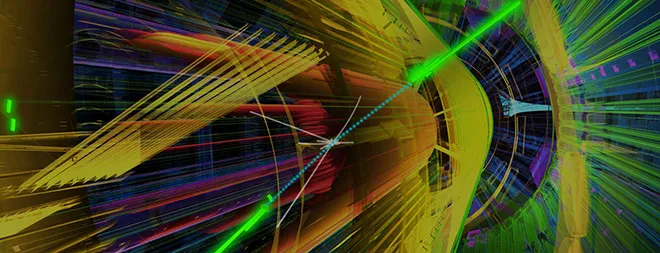
Most hunts for dark matter involve giant underground detectors looking for rare collisions between ordinary matter and dark-matter particles streaming through Earth. However, many theories suggest the most powerful particle accelerator yet, the Large Hadron Collider, could generate dark-matter particles. Although these dark-matter particles would escape through the machine's detectors unnoticed, scientists onsite at the LHC near Geneva, Switzerland, or those around the world who interpret the data, could infer the existence of dark matter by how other remnants of collisions behave. They could use the data from collisions to glean details about bits of dark matter, such as their masses and their cross-sections — that is, how likely they interact with other particles.
Past searches for dark matter at LHC looked for single jets of particles that result when protons are smashed together with unprecedented levels of energy. During the 2012 LHC run, the ATLAS collaboration experimented with more complex collisions generating not only a single large jet but two additional narrow jets.
These new findings strongly rule out a number of potential candidates for dark matter, research detailed online in the journal Physical Review Letters. Specifically, this work "places interesting constraints on attempts to extend the Standard Model of particle physics in a minimal way to explain dark matter," said astroparticle physicist Gianfranco Bertone at the University of Amsterdam, who did not take part in this research.
Get the world’s most fascinating discoveries delivered straight to your inbox.
Although these findings rule out some possible candidates for dark matter, "I don't think it actually produces a big problem for most dark-matter theories, for the moment," said particle physicist Andreas Hoecker, deputy coordinator of the ATLAS Experiment at CERN. "The best theory we have for dark matter, supersymmetry, is not excluded by these results."
Scientists are now upgrading the accelerators at the LHC. "In the middle of 2015, the accelerator will restart and be capable of almost twice more energy than before," Hoecker said. That means future experiments "could look for the formation of supersymmetry particles, such as squarks and gluinos and neutralinos with much larger masses than previous data allowed." The LHC experiments are not expected to detect axions, since they theoretically have very low cross-sections beyond the accelerator's capabilities.
Moreover, in about 2022, the LHC should also upgrade to 10 times higher luminosity — that is, blast 10 times more protons at targets per run. This may generate potential dark-matter particles in larger numbers than before, perhaps enough to detect them despite how rarely they interact with other particles, Hoecker added.
If LHC does not detect anything even at higher energies and luminosities, "it is very difficult to rule out supersymmetry models completely, but scientists would probably lose interest," Bertone said. "Researchers would then likely have to move to something different."
Inside Science News Service is supported by the American Institute of Physics. Charles Q. Choi is a freelance science writer based in New York City who has written for The New York Times, Scientific American, Wired, Science, Nature, and many other news outlets. He tweets at @cqchoi.