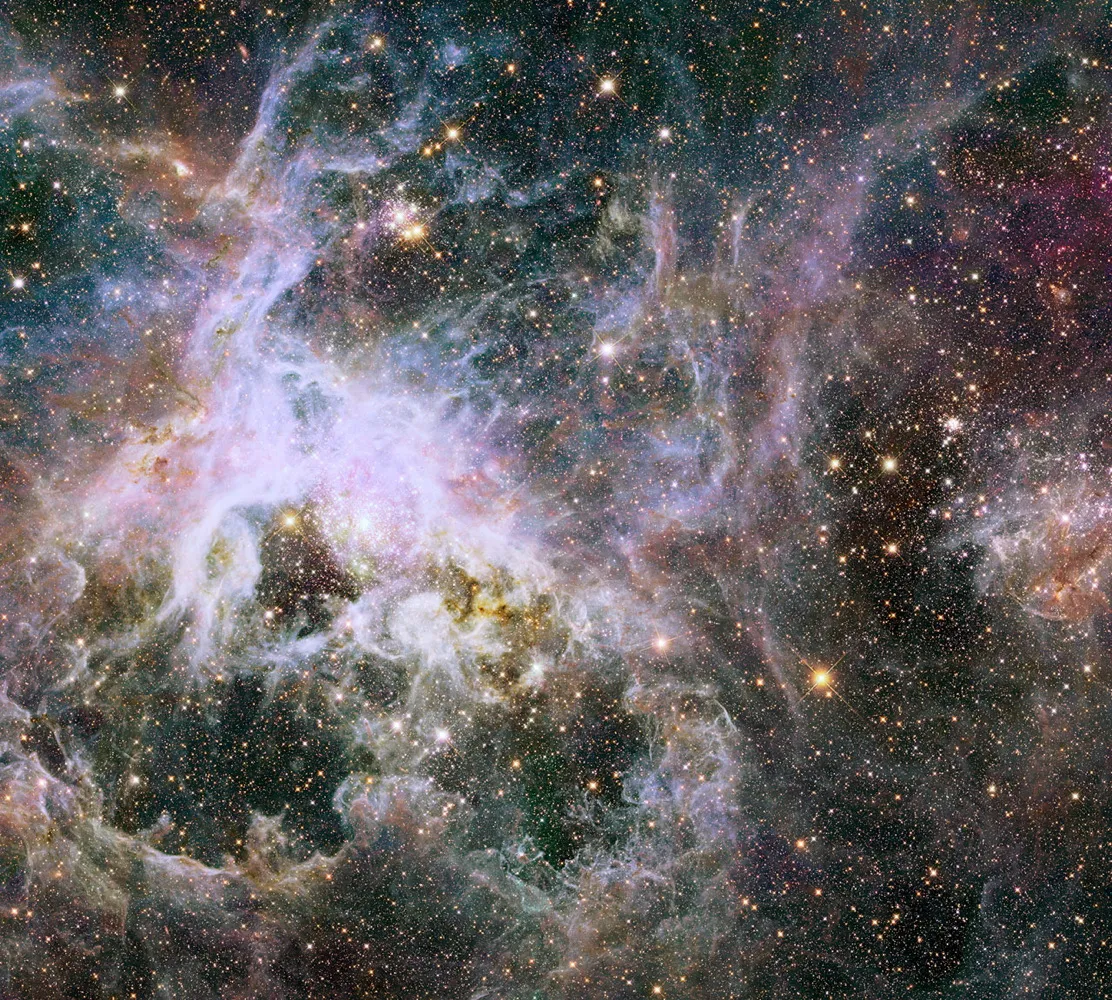
This new Hubble image shows a cosmic creepy-crawly known as the Tarantula Nebula in infrared light. This region is full of star clusters, glowing gas, and thick dark dust. Image released Jan. 9, 2014.
WASHINGTON — New views from the Hubble Space Telescope are revealing the spooky-looking Tarantula Nebula in never-before-seen detail.
The Tarantula Nebula is located about 160,000 light-years from Earth in the Large Magellanic Cloud, one of the closest galaxies to the Milky Way. The prolific Hubble Space Telescope produced the image, which shows multicolored clouds of gas and dust glowing with stars sprinkled throughout the image.
Hubble officials previously released images of the spidery nebula, however, this is the deepest view of the intriguing cosmic region full of star clusters yet. [See the amazing new Tarantula Nebula photos]
"The image is dominated by gas and dust, but I can assure you that there are more than 800,000 stars living in this region," Elena Sabbi, of the Space Telescope Science Institute, said as she unveiled the new image here at the 223rd meeting of the American Astronomical Society. "To see them, you have to strip away the veil the dust is causing and then you can admire the stars in this region. This is a very efficient way to identify where stars are forming nowadays in the Tarantula Nebula."
Created using observations taken as part of the Hubble Tarantula Treasury Project (HTTP), these images were snapped using Hubble's Wide Field Camera 3 (WFC3) and Advanced Camera for Surveys (ACS). Image released Jan. 9, 2014.
(Image credit: NASA, ESA, E. Sabbi (STScI))
The impressive star cluster located on the left center portion of the image is actually a super star cluster called R136. The massive group of stars could eventually become a globular cluster — bunches of old stars orbit the centers of their galaxies.
This ground-based view of the Tarantula Nebula shows the nebula in its entirety. It is the brightest region of star formation in the local Universe. Hubble’s field of view covers just a tiny spot in the upper-right quadrant of this image, though it reveals detail invisible here, including a supernova remnant. Image released March 15, 2011.
(Image credit: NASA, ESA, Digitized Sky Survey 2. Acknowledgement: Davide De Martin)
Much of the Tarantula Nebula's visibility is actually due to R136 thanks to the amount of energy produced by the super star cluster.
The image was created as part of the Hubble Tarantula Treasury Project, an initiative to map stars within the nebula in order to understand its structure more thoroughly. The Tarantula Nebula represents an environment that could be similar to the extreme conditions that existed during the early universe, Hubble officials said.
Sign up for the Live Science daily newsletter now
Get the world’s most fascinating discoveries delivered straight to your inbox.
The new image is also used in an electronic book called Reach for the Stars: Touch, Look, Listen, Learn. While the new book is designed for children for visual impairments, anyone can use it to explore the complex nebula. The book will be available for free on iPad.
"We hope it will be an inspiration and attract people to science," Sabbi said in a statement. "That's the main goal. We want to convince children that science is cool, is fun, and that anybody could be a scientist, if they want to."
Miriam Kramer joined Space.com as a staff writer in December 2012. Since then, she has floated in weightlessness on a zero-gravity flight, felt the pull of 4-Gs in a trainer aircraft and watched rockets soar into space from Florida and Virginia. She also serves as Space.com's lead space entertainment reporter, and enjoys all aspects of space news, astronomy and commercial spaceflight. Miriam has also presented space stories during live interviews with Fox News and other TV and radio outlets. She originally hails from Knoxville, Tennessee where she and her family would take trips to dark spots on the outskirts of town to watch meteor showers every year. She loves to travel and one day hopes to see the northern lights in person.