













US Preterm Birth Rate Lowest in 15 Years

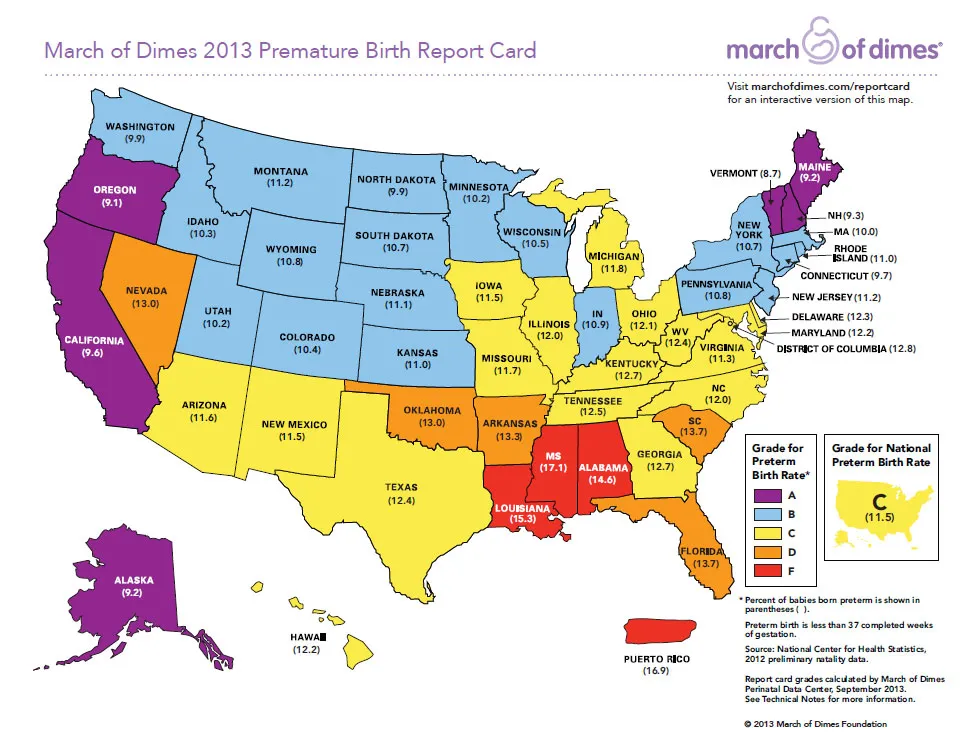
The percentage of babies born early in the United States has reached a 15-year low, according to a new report.
In 2012, the U.S. preterm birth rate was 11.5 percent, down from 11.7 percent the year before, the report says.
A baby is considered preterm if he or she is born before 37 weeks of pregnancy.
The country's preterm birth rate peaked in 2006 (at 12.8 percent), but has declined each year since, resulting in an estimated 176,000 fewer babies born preterm over the six-year period, according to the March of Dimes, the charity organization that released the report. [7 Baby Myths Debunked]
The March of Dimes also gave each state a grade based on how much progress the state had made towards the 2020 preterm birth rate goal of 9.6 percent — an annual "report card" that the organization started in 2008.
For the first time, California received an "A", a notable achievement given the state's large and diverse population.
"I think California is an important example here," said Dr. Edward McCabe, chief medical officer of the March of Dimes. "For such a diverse state to make this kind of advance in reducing its preterm birth rate — this is a remarkable feat," McCabe said.
Get the world’s most fascinating discoveries delivered straight to your inbox.
California, which has the most births of any state, has been a leader in implementing strategies to reduce preterm birth, such as efforts to decrease elective deliveries before 39 weeks, McCabe told LiveScience.
Being born just a few weeks too early can increase a baby's risk of health problems — babies born between 34 and 36 weeks of pregnancy have triple the risk of death, compared with babies born between 39 and 40 weeks, McCabe said.
Despite the progress, more needs to be done to reduce preterm births, the March of Dimes says. The United States still has one of the highest preterm birth rates among industrialized countries, and overall, received a "C" on the March of Dimes report card.
"We must continue to invest in premature birth prevention because every baby deserves a healthy start in life,” said Dr. Jennifer Howse, president of the March of Dimes.
Follow Rachael Rettner @RachaelRettner. Follow LiveScience @livescience, Facebook & Google+. Original article on LiveScience.

Rachael is a Live Science contributor, and was a former channel editor and senior writer for Live Science between 2010 and 2022. She has a master's degree in journalism from New York University's Science, Health and Environmental Reporting Program. She also holds a B.S. in molecular biology and an M.S. in biology from the University of California, San Diego. Her work has appeared in Scienceline, The Washington Post and Scientific American.