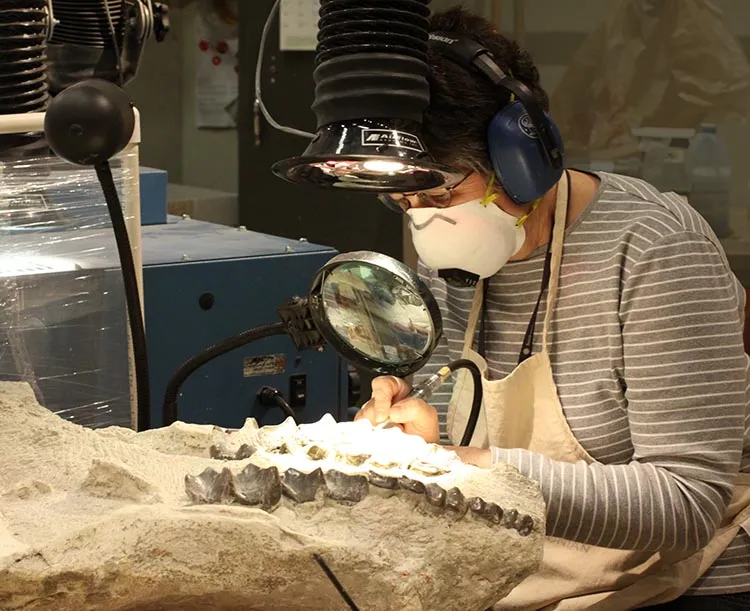
Lynn Russo uses an air scribe to remove rock from a fossil brontothere skull. Brontotheres were rhinoceros-like relatives of horses and tapirs that went extinct about 35 million years ago. This fossil was found in South Dakota.
(Image credit: Smithsonian National Museum of Natural History)
In FossiLab, a fossil preparation laboratory that puts the preparators on exhibit, Russo devotes her time to removing rock that encases the fossil skull of a large, extinct rhino-like animal called a brontothere.
The lab is conspicuously nestled in the paleontology hall at the Smithsonian National Museum of Natural History (NMNH). It is a small room with windows on all sides where museum visitors watch volunteers like Russo at work.
Volunteers are critical members of the NMNH Department of Paleobiology, assisting staff with everything from scanning old field-notebooks and slides to helping prepare fossils for scientific study. Specially trained in fossil-preparation techniques, Russo has been at work on her project for more than two years, with only occasional help from other volunteers. (Her progress during that period is captured in a short slide show.)
"It takes that long?" is the question Russo is often asked by visitors to FossiLab when they learn how much time is involved in uncovering the skull. Each fossil-preparation project presents a unique set of challenges, but in this case, Russo must grapple both with the similar appearance of the bone and the rock that surrounds it — they are almost the same color — and the fact that the hard surface of the bone was roughly abraded by sediment before it was preserved. This left the softer, spongy interior exposed in places. So, not only is it hard to tell the rock that must be removed from the bone embedded in it, but it is very difficult to remove the surrounding rock matrix without damaging the fossil.
Much of the time, Russo uses a tiny jackhammer-like tool known as an air scribe to chip away at the rock, but when she works near the spongy areas of the bone, she switches to a gentler tool — basically a large needle — to scrape the rock away, bit by bit. Russo frequently brushes water onto the specimen as she works, because the bone and matrix reflect light differently when they are wet, making it easier to tell them apart. And, when she uncovers sections of fragile bone, Russo applies protective adhesives.
Sign up for the Live Science daily newsletter now
Get the world’s most fascinating discoveries delivered straight to your inbox.
Charles W. Gilmore wrote of the Diplodocus, shown here newly mounted in the Smithsonian Dinosaur Hall in the 1930s, "The magnitude of the task ... of preparing one of these huge skeletons for public exhibition can be fully appreciated only by those who have passed through such an experience."
(Image credit: Smithsonian National Museum of Natural History)
Progress on the brontothere skull is very slow, but that is the nature of fossil work. The giant Diplodocus skeleton in the neighboring Dinosaur Hall, collected in 1924 by Charles W. Gilmore, arrived at the museum, he wrote, as "26 tons of rock-enclosed bone." This extraordinary skeleton required 2,545 working days to excavate, prepare and mount. Compared to that job, Russo has it pretty easy!
Gilmore's 1932 article on the Diplodocus skeleton is available as a Biodiversity Heritage Library scan. His 1942 accounting of time spent preparing the Diplodocus for exhibit is on page 342 of this scan of his article "A History of the Division of Vertebrate Paleontology in the United States National Museum."
More historical photos of our fossil exhibits and of work in the Department of Paleobiology can be found on our website.