













Secret Revealed: The Physics of How Penguins Stay Warm

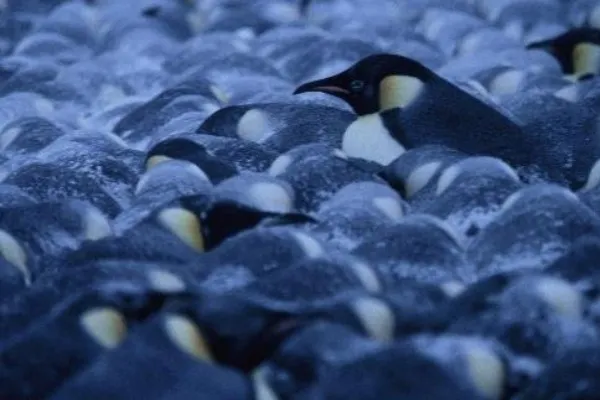
For penguins trying to survive a harsh Antarctic winter, huddling is a matter of life or death. Birds within a colony crowd together so tightly that individual movements are impossible. Collective movements are a must, however: The penguins on the periphery would die of cold if they weren't continuously being reshuffled toward the center of the crowd.
But how does this constant, collective reorganization happen? How does a huddle of millions shuffle itself without crushing anyone? Physics, as it turns out. Penguins move through the huddle in the same way that sound waves propagate through a fluid only much more slowly.
"Every 30 to 60 seconds, all penguins make small steps that travel as a wave through the entire huddle," writes Daniel Zitterbart, a physicist at the University of Erlangen-Nuremberg in Germany, who wrote the new research paper along with his colleagues in the journal PLoS ONE.
In a highly coordinated manner, the emperor penguins the researchers studied each took miniscule steps measuring just 2 to 4 inches (5 to 10 centimeters). "Over time, these small movements lead to large-scale reorganization of the huddle," they wrote. [Read: Why Don't Penguin Feet Freeze On Ice? ]
The traveling wave of small steps is similar to how a sound wave travels through a fluid, the researchers noted. "In general, individual penguins do not change their position relative to their neighbors, and they do not force their way in or out of a huddle."
Penguins are much better at "going with the flow" than humans, who also tend to move in waves when packed together in large, dense crowds, but sometimes end up getting crushed. "Why these waves are uncoordinated, turbulent and dangerous in a human crowd but not in a penguin huddle remains an open question," Zitterbart and his colleagues wrote.
- Why Don't Woodpeckers Get Headaches?
- How Is Crowd Size Estimated?
- Penguins' Oxygen Trick: How They Survive Deep Dives
Follow Natalie Wolchover on Twitter @nattyover.
Get the world’s most fascinating discoveries delivered straight to your inbox.

Natalie Wolchover was a staff writer for Live Science from 2010 to 2012 and is currently a senior physics writer and editor for Quanta Magazine. She holds a bachelor's degree in physics from Tufts University and has studied physics at the University of California, Berkeley. Along with the staff of Quanta, Wolchover won the 2022 Pulitzer Prize for explanatory writing for her work on the building of the James Webb Space Telescope. Her work has also appeared in the The Best American Science and Nature Writing and The Best Writing on Mathematics, Nature, The New Yorker and Popular Science. She was the 2016 winner of the Evert Clark/Seth Payne Award, an annual prize for young science journalists, as well as the winner of the 2017 Science Communication Award for the American Institute of Physics.