













Model Predicts Mob Behavior

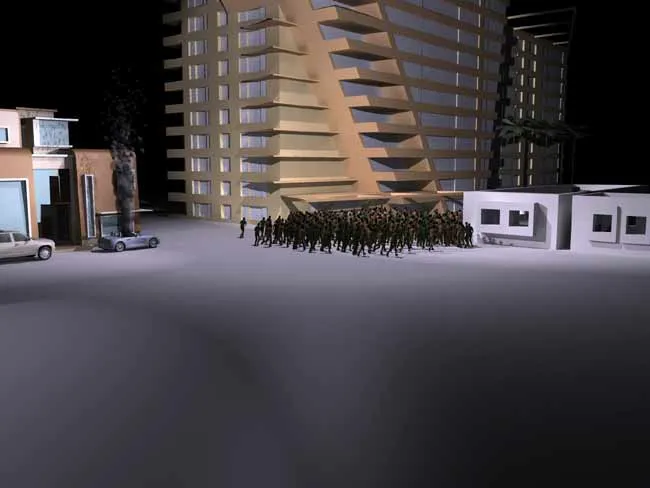
Scientists who want to see how a crowd behaves in an emergency can’t exactly shout “Fire!” on a city street and watch everyone panic and run. But a newly developed computer model can.
The 3-D model starts with patterns of human behavior and movement and uses them to simulate the behavior of a crowd in mob situations and pedestrian habits under certain building configurations, resulting in a virtual crowd video.
“Crowds are vital to the lifeblood of our cities,” said the model’s creator, Paul Torrens of Arizona State University. But, he adds, it is impractical “to establish live experiments with hundreds or thousands of people along busy streetscapes.”
Torrens’s model uses what he calls an “agent-based methodology.” He can put individual people, or “agents,” each with different characteristics of age, sex, size and health, into the model and have them process information about the world around them. Their unique characteristic combinations make the agents interpret that information and react in different ways.
“It’s the same way we process information in the real world,” Torrens said.
Though you’re not aware of it, when you walk down a crowded street, your brain is constantly monitoring your surroundings and planning the path you will take to your destination while simultaneously monitoring for obstacles.
A prototype that Torrens has developed models the evacuation of a crowded area during a fire when there is only one point of escape, but he has used his method to develop a primitive model of a situation in which a disease spreads through casual contact, and he is attempting to create scenarios in which agitated crowds turn into unruly mobs.
Get the world’s most fascinating discoveries delivered straight to your inbox.
The model could also be used in planning cities to optimize walking space for pedestrians and alleviate congestion.
- Video: See the Modeled Evacuation
- Follow the Leader: Democracy in Herd Mentality
- The Science of Traffic Jams

Andrea Thompson is an associate editor at Scientific American, where she covers sustainability, energy and the environment. Prior to that, she was a senior writer covering climate science at Climate Central and a reporter and editor at Live Science, where she primarily covered Earth science and the environment. She holds a graduate degree in science health and environmental reporting from New York University, as well as a bachelor of science and and masters of science in atmospheric chemistry from the Georgia Institute of Technology.