Why Do Golf Balls Have Dimples?
Get the world’s most fascinating discoveries delivered straight to your inbox.
You are now subscribed
Your newsletter sign-up was successful
Want to add more newsletters?
Delivered Daily
Daily Newsletter
Sign up for the latest discoveries, groundbreaking research and fascinating breakthroughs that impact you and the wider world direct to your inbox.
Once a week
Life's Little Mysteries
Feed your curiosity with an exclusive mystery every week, solved with science and delivered direct to your inbox before it's seen anywhere else.
Once a week
How It Works
Sign up to our free science & technology newsletter for your weekly fix of fascinating articles, quick quizzes, amazing images, and more
Delivered daily
Space.com Newsletter
Breaking space news, the latest updates on rocket launches, skywatching events and more!
Once a month
Watch This Space
Sign up to our monthly entertainment newsletter to keep up with all our coverage of the latest sci-fi and space movies, tv shows, games and books.
Once a week
Night Sky This Week
Discover this week's must-see night sky events, moon phases, and stunning astrophotos. Sign up for our skywatching newsletter and explore the universe with us!
Join the club
Get full access to premium articles, exclusive features and a growing list of member rewards.
About a century ago, after someone realized that a scuffed-up ball travels farther than a shiny new one, balls gained dimples. Now manufacturers invest millions of dollars each year to design better performing golf balls.
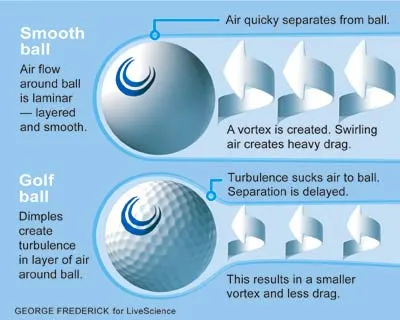
The dimples in golf balls create turbulence, or mixed airflow, which, if done right, reduces drag.
Here's how it works:
There are two main types of airflow — laminar and turbulent. Laminar movement creates less drag but is vulnerable to "separation" — a phenomenon whereby the air layer that clings to the ball as it moves through the air separates from the ball. Turbulent flow creates more drag initially, but is less vulnerable to separation.
At high speeds, like that of a flying golf ball, you want this air layer to cling to the ball as long as possible, and the added dimples do just that.
Follow Life's Little Mysteries on Twitter @llmysteries. We're also on Facebook & Google+.
Get the world’s most fascinating discoveries delivered straight to your inbox.