














Lights at Night: Moscow from Space

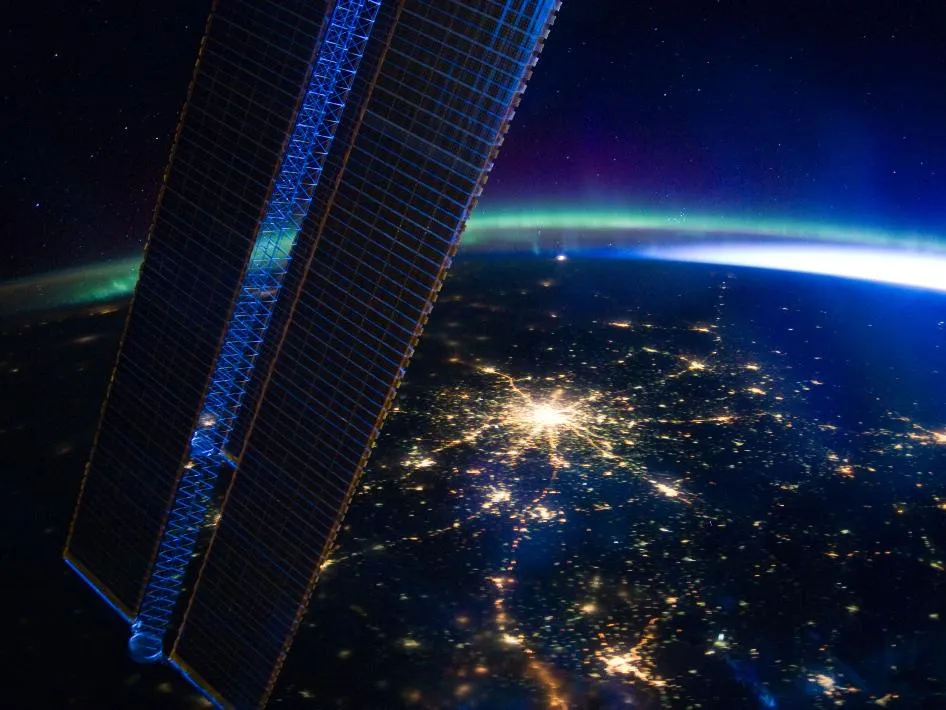
The spiderlike shape of Moscow appears at the center of this nighttime image taken by astronauts aboard the International Space Station.
ISS crew members have a unique perspective on the Earth below them, flying at an altitude high enough to take in whole features and regions of the planet, but near enough to still make out interesting details. Astronauts can capture images of the Great Barrier Reef (the world's largest living structure, and the only living structure visible from space), Mount Everest and its fellow Himalayan peaks, the Grand Canyon in the U.S. Southwest, and lit-up cities across the world.
The ISS was at an altitude of about 240 miles (386 kilometers) when members of the Expedition 30 crew snapped this image on March 28. One of the station's solar array panels takes up the left side of the image.
Also seen in the image is the green glow of the aurora borealis, which astronauts often see from their lofty perch, and sometimes even fly through. Auroras occur in a region of the atmosphere between 60 miles (100 km) to 250 miles (400 km), which makes the ISS perfectly positioned to observe them.
Faint lines of airglow, caused by ultraviolet radiation exciting the gas molecules in the Earth's upper atmosphere, are also seen in the image.
The bright white light in the upper right corner of the image is daybreak, as the sun's rays begin to peak around the Earth. Astronauts see 16 sunrises and sunsets on average in one 24-hour orbit of the planet.
Expedition 30 crew members include NASA astronauts Don Pettit and Daniel Burbank, Russian cosmonauts Oleg Kononenko, Anton Shkaplerov and Anatoly Ivanishin, and Dutch astronaut Andre Kuipers of the European Space Agency (ESA).
Get the world’s most fascinating discoveries delivered straight to your inbox.
