















Small Spiders Get More Action

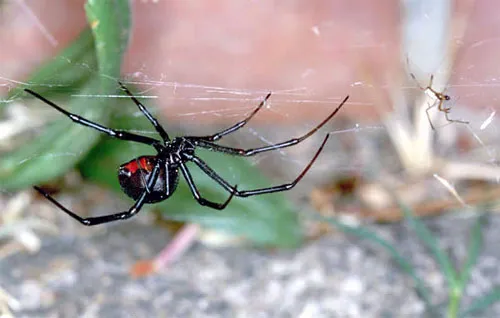
Smaller male spiders get more action than their bigger counterparts because they mature faster and are quicker on their feet, new research shows. Researchers directly observed two competitive contexts between differently sized male redback spiders (Latrodectus hasselti) in real time. When large and small male spiders in the same vincinity competed head-to-head for mating rights, the larger males were more dominant at mating with and impregnating the females because the larger ones had more competitive strengths. However, when the smaller males were given a one-day head start, reflecting their shorter maturation times in nature, they had a 10-times higher paternity rate than larger males. Courtship between redbacks lasts an average of 50 minutes when males are competing and 4.5 hours for single, non-competing males. Copulation lasts from six to 31 minutes, and males are usually injured or killed during the process. "The results reveal that big males don't get it all their own way," said Michael Kasumovic, postdoctoral fellow at the University of New South Wales who co-authored a paper on the results with Maydianne Andrade of the University of Toronto. The research is published online in the current issue of Journal of Evolutionary Biology. "Nature favors larger and smaller males under different circumstances," Kasumovic said. "Larger males experienced a longer maturation process so they are unable to search for and mate with females and produce offspring at the same rate as smaller redback spiders." Evidence from studies of midges, dung flies and seed beetles reveals that smaller males develop sooner than larger males and often mate before larger competing males arrive on the scene, Kasumovic said. "Size isn't the only ruler by which we can measure a male's quality. Many other factors, including maturation time, are critical in that definition," he said.
- Creepy Spiders: The Best of Your Amazing Images
- Top 10 Insect Secret Weapons
- Mating Game: The Really Wild Kingdom
Get the world’s most fascinating discoveries delivered straight to your inbox.
