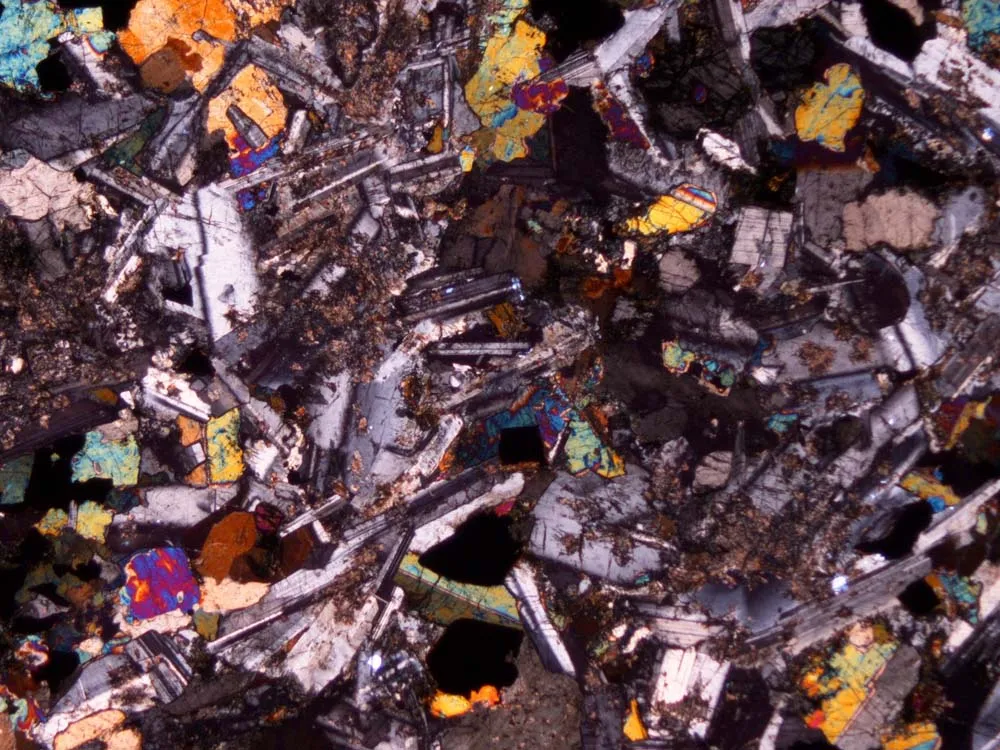
A microscopic image of a rock with red-brown tranquillityite crystals as well as brightly colored pyroxene crystals and grey-white-black feldspar crystals.
A mineral once found only on the moon has now been discovered in billion-year-old rocks in Australia.
Tranquillityite is a mineral consisting of iron, zirconium, yttrium, titanium, silicon and oxygen. It is named after the moon's Sea of Tranquility, where it was first discovered on the Apollo 11 mission. Until now, it was only seen in samples returned from the moon, as well as in lunar meteorites — that is, rocks blasted off the moon's surface by cosmic impacts that crash-landed here.
Now scientists have identified what appear to be terrestrial versions of tranquillityite in Western Australia.
The mineral commonly occurs as clusters of thin, narrow, fox-red strips in dikes or sills — bodies of rock that likely originally intruded as magma into surrounding layers of stone. Its composition is largely the same as lunar tranquillityite.
"What I find the most surprising is that it took more than 40 years to find tranquillityite in rocks on Earth," said researcher Birger Rasmussen, a geologist at Curtin University in Bentley, Australia.
"Tranquillityite was probably not found until now because it is relatively rare and small," Rasmussen told OurAmazingPlanet. "Tranquillityite is also prone to alteration during later heating and fluid flow."
The usual techniques used by geologists to examine the dolerite rocks that terrestrial tranquillityite was ultimately found in also might have missed the mineral. Scientists usually analyze dolerite by crushing it, while Rasmussen and his colleagues investigated polished slices of it under a scanning electron microscope, he said.
Sign up for the Live Science daily newsletter now
Get the world’s most fascinating discoveries delivered straight to your inbox.
Their research of rocks from Western Australia suggests tranquillityite is a relatively widespread, albeit minor, mineral there.
A red-brown tranquillityite crystal about 150 microns long from northwestern Australia.
(Image credit: Birger Rasmussen.)
"I think we will find that it is much more widespread on Earth — there is no reason that it should be restricted to Western Australia," Rasmussen said.
Tranquillityite could help scientists better understand the history and geology of the Earth and the moon, because it has a set of properties that make it excellent for the uranium-lead method of estimating the age of very old rocks. Rasmussen and his colleagues used tranquillityite they found to establish that volcanic rocks in northwestern Australia were about 1 billion years old, showing the sedimentary rocks they intruded upon "were much older than previously supposed," Rasmussen said.
The scientists detailed their findings in the January issue of the journal Geology.
Charles Q. Choi is a contributing writer for Live Science and Space.com. He covers all things human origins and astronomy as well as physics, animals and general science topics. Charles has a Master of Arts degree from the University of Missouri-Columbia, School of Journalism and a Bachelor of Arts degree from the University of South Florida. Charles has visited every continent on Earth, drinking rancid yak butter tea in Lhasa, snorkeling with sea lions in the Galapagos and even climbing an iceberg in Antarctica.