














Ancient Meteorite Blast Resembled Volcanic Eruption

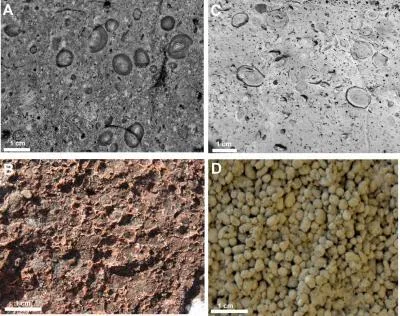
A billion years ago, a meteorite slammed into the Earth along the coast of what is now Scotland. A forensic investigation by a team of volcanologists has pieced together exactly how the debris from the impact devastated the surrounding region.
The new research shows that some aspects of giant meteorite impacts may mimic the behavior of large volcanic eruptions.
Meteorite impacts are more common than most people realize, but what happens when the meteorite hits? Direct observation is understandably difficult, but researchers can pick through impact debris that hasn't eroded away and then forensically reconstruct these catastrophic events.
The volcanologists say that an improved understanding of what happens when large objects hit the Earth will help us understand how such events affect life on the planet.
Volcanologists analyzed a layer of ejected debris from this huge meteorite impact and discovered that much of the debris moved across the ground as rapid, dense, ground-hugging currents of gas and debris, remarkably similar to the pyroclastic density currents fast-traveling streams of hot ash and rock that flow outward from explosive volcanoes.
"In particular, the way that ash and dust stick together seems identical," said study team member Mike Branney of the University of Leicester in England. "Moist ash from explosive volcanoes sticks together in the atmosphere to fall out as millimeter-sized pellets. Where these drop back into a hot pyroclastic density current, they grow into larger layered structures, known as accretionary lapilli."
The researchers studied the finely preserved deposit in northwest Scotland from the ancient impact. It shows both types of these 'volcanic' particles pellets and lapilli are produced.
Get the world’s most fascinating discoveries delivered straight to your inbox.
"This reveals that that the 10 meter-thick [33 feet] layer, which has been traced for over 50 km [31 miles] along the Scottish coast, was almost entirely emplaced as a devastating density current that sped outwards from the point of impact just like a density current from a volcano. Only the uppermost few centimeters actually fell out through the atmosphere," said study team member Richard Brown of the University of Durham.
- Meteor Crater: Experience an Ancient Impact
- 7 Ways the Earth Changes in the Blink of an Eye
- Fallen Stars: A Gallery of Famous Meteorites
Follow OurAmazingPlanet for the latest in Earth science and exploration news on Twitter @OAPlanet and on Facebook.
