Chile Volcano Still Smoking, But Quietly
Get the world’s most fascinating discoveries delivered straight to your inbox.
You are now subscribed
Your newsletter sign-up was successful
Want to add more newsletters?
Delivered Daily
Daily Newsletter
Sign up for the latest discoveries, groundbreaking research and fascinating breakthroughs that impact you and the wider world direct to your inbox.
Once a week
Life's Little Mysteries
Feed your curiosity with an exclusive mystery every week, solved with science and delivered direct to your inbox before it's seen anywhere else.
Once a week
How It Works
Sign up to our free science & technology newsletter for your weekly fix of fascinating articles, quick quizzes, amazing images, and more
Delivered daily
Space.com Newsletter
Breaking space news, the latest updates on rocket launches, skywatching events and more!
Once a month
Watch This Space
Sign up to our monthly entertainment newsletter to keep up with all our coverage of the latest sci-fi and space movies, tv shows, games and books.
Once a week
Night Sky This Week
Discover this week's must-see night sky events, moon phases, and stunning astrophotos. Sign up for our skywatching newsletter and explore the universe with us!
Join the club
Get full access to premium articles, exclusive features and a growing list of member rewards.
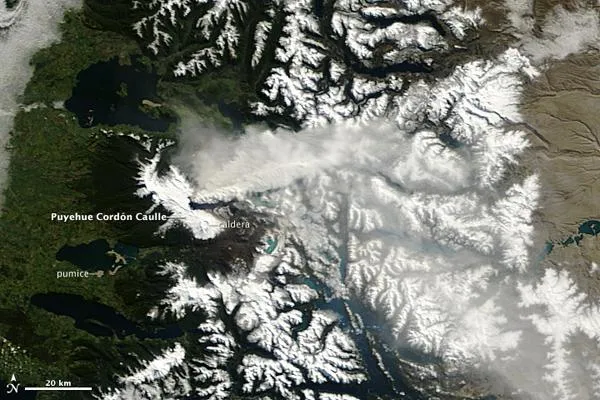
For two and a half months Chile's Puyehue Cordón Caulle Volcanic Complex has erupted nearly continuously. Since the violent initial stages of the eruption, that hurled pumice tens of kilometers from the eruption site, Puyehue Cordón Caulle has settled into a mild phase. Emissions of fine ash and volcanic gases are accompanied by volcanic tremor continuous, rhythmic ground shaking.
On the morning of August 14, 2011, the volcano emitted an ash plume that streamed east-northeast over Argentina, where it dispersed to the southwest. According to the Joint Air Force & Army Weather Information Network the ash plume reached 12,000 feet (3,700 meters) at the time. The summit of Puyehue (the caldera to the southwest of the active vent) is 7,336 feet (2,236 meters). This natural-color satellite image was acquired on the morning of August 14, 2011, by the Moderate Resolution Imaging Spectroradiometer (MODIS) aboard the Terra satellite.
- In Images: Spectacular Sunsets Courtesy of Chile Volcano
- Chilean Volcano Colors Southern Hemisphere Skies
- In Images: Chilean Volcano Erupts
Get the world’s most fascinating discoveries delivered straight to your inbox.