NASA's Cloud-Aerosol Lidar and Infrared Pathfinder Satellite Observation (CALIPSO) satellite was in the right place at the right time at the beginning of this year.
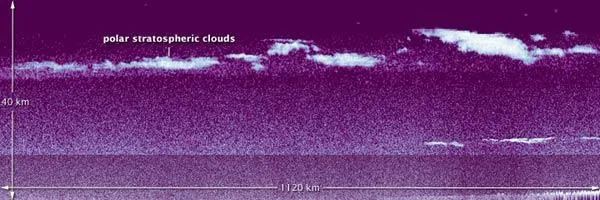
On Jan. 4, while flying past the east coast of Greenland, CALIPSO caught a top-down glimpse of an unusual atmospheric phenomenon polar stratospheric clouds (PSCs), also known as nacreous clouds.
Clouds do not usually form in the stratosphere, the cold layer of the Earth's atmosphere above the layer in which we live and in which most weather occurs (called the troposphere), because the stratosphere is very dry.
But in the polar regions, often near mountain ranges, atmospheric gravity waves in the troposphere can push just enough moisture into the high altitudes. The extremely low temperatures of the stratosphere condense ice and nitric acid into clouds that play an important role in depletion of stratospheric ozone, which protects us from the sun's harmful ultraviolet rays.
The top image was assembled from data from CALIPSO's Light Detection and Ranging instrument, or lidar, which sends pulses of laser light into Earth's atmosphere. The light bounces off particles in the air and reflects back to a receiver that can measure the distance to and thickness of the particle- and air masses below.
(Image credit: NASA)
This cloud reached an altitude of more than 19 miles (30 kilometers). CALIPSO has observed stratospheric clouds before, but never one this high, saidMike Pitts, an atmospheric scientist at NASA's Langley Research Center, in a NASA statement.
The map shows the flight path of the satellite,which flew for 695 miles (1,120 km) from north to south over the Greenland Sea and Denmark Strait.
Sign up for the Live Science daily newsletter now
Get the world’s most fascinating discoveries delivered straight to your inbox.
For the science geek in everyone, Live Science offers a fascinating window into the natural and technological world, delivering comprehensive and compelling news and analysis on everything from dinosaur discoveries, archaeological finds and amazing animals to health, innovation and wearable technology. We aim to empower and inspire our readers with the tools needed to understand the world and appreciate its everyday awe.