














Iran's Salty Lakes Wax and Wan

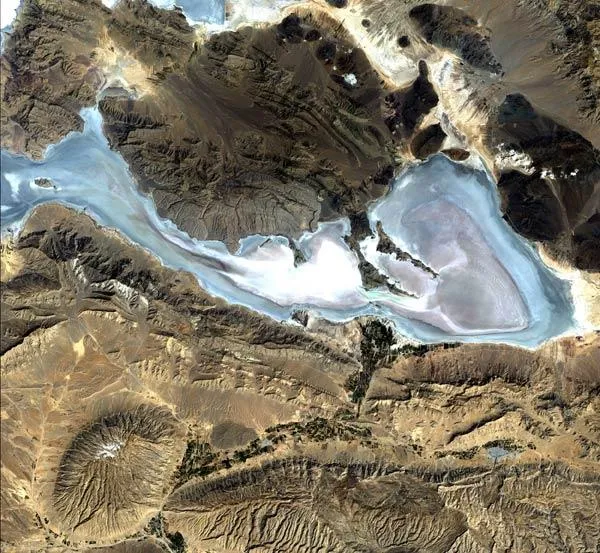
Lakes Bakhtegan and Tashk (together known as the Neyriz Lakes) in the Fars Province in southern Iran are featured in this image acquired by ALOS Japan's four-tonne Earth observation satellite.
Lake Bakhtegan (center) and Lake Tashk (top), situated in the Neyriz Basin, are salty lakes in the southeastern Zagros Mountains with fluctuating water levels according to rain and snowfall in the mountains.
Lake Bakhtegan, Iran's second largest lake, is fed mostly by the Kur River, while Lake Tashk is fed by overflow from the marshes at its west end and by a large permanent spring in the northwest.
Although normally separated by narrow strips of land, during years of heavy rainfall they may join to form a single lake. Likewise, after years of low rainfall, such as in 1934 and 1971, the lakes may dry out completely except in the area near the springs, according to a European Space Agency statement.
Supporting more than 20,000 waterfowl during the migration seasons and in winter, the lakes are extremely important for breeding of a wide variety of species and helping to maintain the genetic and ecological diversity of the region.
The two lakes, their delta and spring-fed marshes are designated as Wetlands of International Importance by the Ramsar Convention on Wetlands. The Ramsar Convention on Wetlands is an inter-governmental treaty established in 1971, establishing a framework for the stewardship and preservation of wetlands.
The Bakhtegan National Park, a wildlife park, sanctuary and reserve, is visible in the top center of the image above Lake Bakhtegan.
Get the world’s most fascinating discoveries delivered straight to your inbox.
