













Solar Cells Go Organic
Editor's Note: ScienceLives is an occasional series that puts scientists under the microscope to find out what makes them tick. The series is a cooperation between the National Science Foundation and LiveScience.
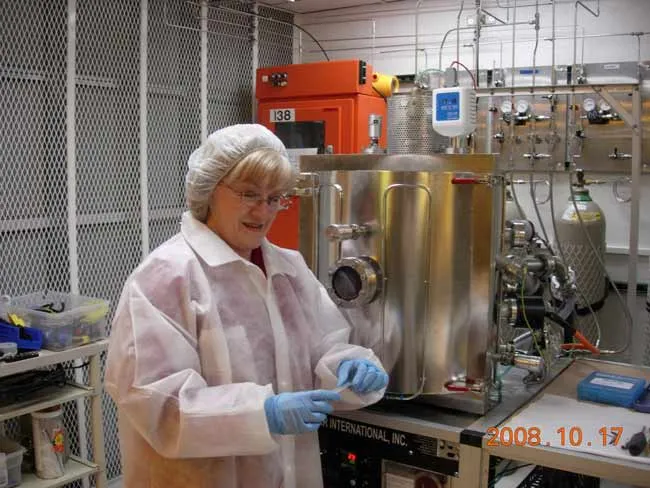
Name: Diane M. Hinkens Institution: South Dakota State University Field of Study: Organic Chemistry
What inspired you to choose this field of study? Originally, I was a clothing designer, but from whenever I can remember, I always wanted to be a scientist.
What is the best piece of advice you ever received? Never give up. Never give up on your dream, be true to yourself.
What was your first scientific experiment as a child? Growing up in Wisconsin, the oldest girl in a family of 10 children, I had little opportunity for scientific experimentation. In fact, my determination to become a scientist was fueled by resistance to my experiences as a young woman.
What is your favorite thing about being a scientist or researcher? I like how scientists devise ways to figure out answers to their questions. I also like making chemical compounds in the lab, and understanding how things work.
What is the most important characteristic a scientist must demonstrate in order to be an effective scientist? When I was a graduate student in organic chemistry, my professor was knowledgeable and exacting, and I was observant when I did my experiments. Together we were a good team. I think we're all realizing that science is teamwork, so we need to have trust and good communication.
Get the world’s most fascinating discoveries delivered straight to your inbox.
What are the societal benefits of your research? The capture of sunlight and conversion to electrical energy through solar cells promises a clean and readily available energy source. However, today's silicon-based solar cells are too expensive to truly compete with fossil fuels. My research goal, along with my advisor Qiquan Qiao from South Dakota State University and collaborator Seth Darling from Argonne National Laboratory, is to develop novel organic, or carbon-based, solar cells that will enable conversion of sunlight to energy more efficiently and cheaper than current methods, thereby making the sun's energy accessible to all people.
Who has had the most influence on your thinking as a researcher? Reading the dialogues that Daisaku Ikeda had with other scientists and educators gave me the courage to pursue my dream of becoming a researcher. These works include published dialogues with Linus Pauling (chemist), Chandra Wickramasinghe (astronomer) and Mikhail Gorbachev. What I learned about was the many struggles of these people and the important role of those struggles in making their contributions to the world.
What about your field or being a scientist do you think would surprise people the most? That women can be really good scientists—because they like open dialogue and sharing their ideas; they are conscientious, and they bring a unique perspective to solving research problems.
If you could only rescue one thing from your burning office or lab, what would it be? I have learned that a laboratory can be a dangerous place; I would rescue the people.
What music do you play most often in your lab or car? Except for country music, whatever's playing is fine with me. But when I'm reading, I need quiet.
This researcher is supported by the National Science Foundation (NSF), the federal agency charged with funding basic research and education across all fields of science and engineering.