
















Grand Staircase Holds Earth's History

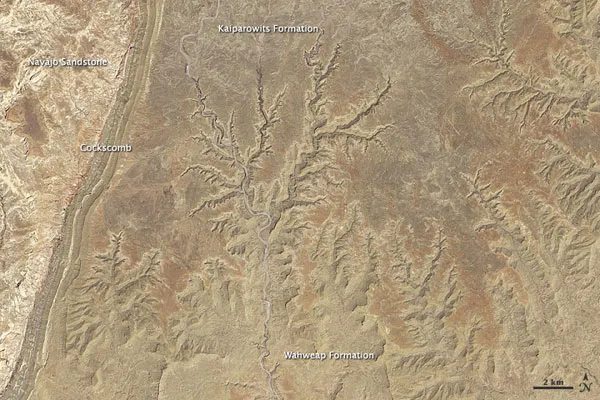
On May 15, 2005, NASA's Earth Observing-1 satellite captured this natural-color image of part of the Kaiparowits Basin, a central portion of the Grand Staircase of Escalante National Monument in Utah.
The Grand Staircase itself preserves a visible timeline spanning almost 275 million years.
The oldest rocks of the feature date from the Permian Period (about 290 to 250 million years ago), when the land that is now Utah was located on the equator, while some of the youngest rocks date from the Eocene Epoch (about 55 to 35 million years ago), when crocodiles and palm trees lived above the Arctic Circle. Many of the rock layers present in the national monument date to the time of the dinosaurs.
In this image, the branch-like shapes are networks of canyons carved by rivers that dried up millions of years ago. The area receives far less precipitation than it did in ages past.
The ridge running roughly north-south through the scene is the Cockscomb. West of the Cockscomb is the Navajo Sandstone, dating from the Triassic (250 to 200 million years ago). East of the Cockscomb are two formations from the Cretaceous: the light-toned Wahweap and darker Kaiparowits.
In September 2010, two new dinosaur species were found in Escalante National Monument. The dinosaurs were both ceratopsians: herbivorous animals characterized by big, flamboyant skulls the well known triceratops is part of this group.
In the late Cretaceous (about 144 to 65 million years ago), when ceratopsian dinosaurs lived, a shallow sea divided North America in two. The shallow sea advanced and retreated multiple times, and an asteroid strike and other calamities about 65 million years ago brought the Age of Reptiles to an end. Since that time, tectonic forces have uplifted the area, leaving it largely high and dry as it remains today.
Get the world’s most fascinating discoveries delivered straight to your inbox.
- All Yours: 10 Least Visited National Parks
- Meteor Crater: Experience an Ancient Impact
- Southwestern United States Spied from Space
