














Drilling into a Volcano Aims to Help Predict Possible Catastrophe
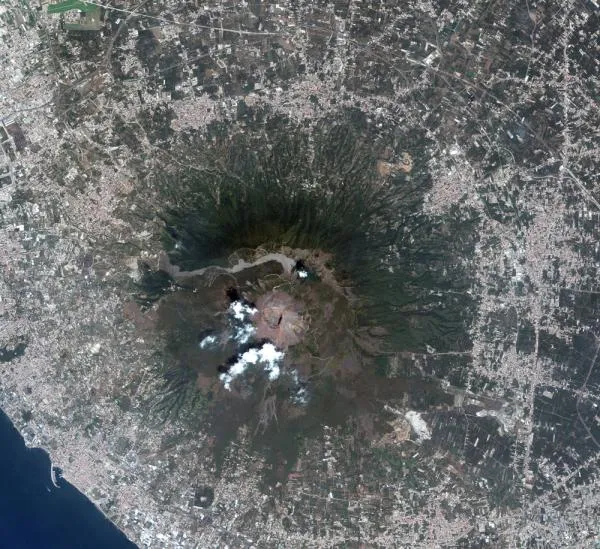
Drilling into an active volcanic doesn't sound like the safest idea, but a plan to do so along a volcano near Naples, Italy, could help protect the city from a potentially catastrophic eruption.
Geologists will drill into the volcanic formation, called Campi Flegrei, early next month. The volcano, part of a larger volcanic arc that includes Mount Vesuvius, last erupted in 1538. The ground around the volcano, however, has been swelling for the past 40 years, stoking fears of an eruption that would threaten the roughly 1 million residents of Naples.
"The role of deep drilling at this area is then crucial," according to the drilling project description by the International Continental Scientific Drill Program (ICDP), which is planning the drilling study.
The drilling will let scientists pull out rocks that will allow them to trace the volcano's evolution, and predict its future.
Drill, baby, drill
The drilling bull's-eye is the eastern part of the Campi Flegrei's caldera, which is about 8 miles (13 kilometers) across. A caldera forms when a volcano collapses into itself after the underlying magma chamber empties, usually from an eruption.
In early October, drillers will test the waters with a short well, and if everything looks good, the drills will plunge thousands of feet into the volcano in the spring of 2011.
Get the world’s most fascinating discoveries delivered straight to your inbox.
The researchers hope to pinpoint the center of the magma simmering beneath the caldera and to lower monitoring equipment into the well to keep tabs on the volcano.
Locals can't help but cast a wary eye on Campi Flegrei these days, due to a phenomenon called bradyseism, or the alternate uplifting and subsiding of the ground over the span of several years. This activity centers on the town of Pozzuoli, which suffered damage from two major uplifts between 1970 and 1972 and between 1982 and 1984.
The scientists have not said whether an eruption might occur anytime soon, but they are monitoring the flow of magma using GPS at Campi Flegrei and other volcanoes, which may improve predictions of eruptions worldwide.
Not in my back yard
Critics say the drilling project will be too close to Naples the caldera is about 9 miles (15 km) west-southwest of the city and could lead to earthquakes, or an explosion, Benedetto de Vivo, a professor of geochemistry at the University of Naples, told Nature News.
Their fears aren't just the cries of volcano-drilling not-in-my-backyarders. A similar project in Iceland was halted last year after it unexpectedly found magma at a depth of just 6,900 feet (2,100 meters). Hitting magma close to the surface could, in theory, trigger an explosion in the well or set off small earthquakes. Having a big city nearby makes these dangers even more worrisome.
Scientists estimate that magma lies at least 23,000 feet (7,000 m) below the surface of the caldera nearly twice as deep as they plan to drill.