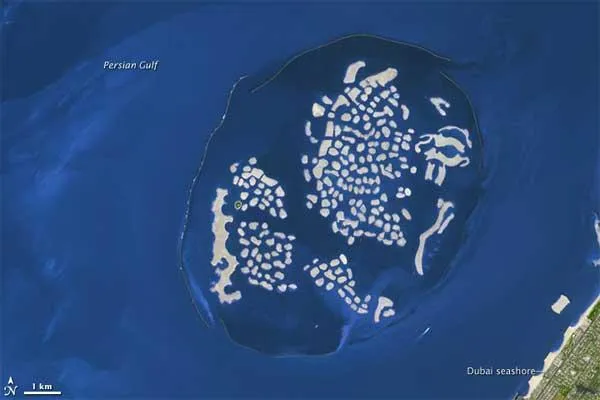
The cluster of islands in this NASA satellite image make up the World Archipelago, an example of how man can mold nature.
The construction of the Archipelago and other shaped islands are an effort by Dubai - one of the seven emirates of the United Arab Emirates - to increase beachfront tourist opportunities around the Persian Gulf . The islands were created by dredging up sand from the sea floor and span an area of about 4 by 6 miles (6 by 9 kilometers).
The groups of islands that make up all of the world's continents are protected by a rock breakwater, which keeps Gulf waves from eroding the artificial islands away.
From south to north, the artificial island sites in this image are Palm Jebel Ali, Palm Jumeirah, The World, and Palm Deira. This NASA Terra satellite image was captured on Sept. 18, 2006.
(Image credit: NASA)
Dubai is also home to the world's tallest building, the Burj Khalifa, which is 2,717 feet (828 meters) high.
Satellite technology has played a role in the construction of these islands, as the sand-spraying ships rely on Global Positioning System (GPS) satellite readings to locate their targets.
Sign up for the Live Science daily newsletter now
Get the world’s most fascinating discoveries delivered straight to your inbox.
Due to extensive experience with land reclamation in their own country, Dutch scientists also assisted with some of the island construction.
For the science geek in everyone, Live Science offers a fascinating window into the natural and technological world, delivering comprehensive and compelling news and analysis on everything from dinosaur discoveries, archaeological finds and amazing animals to health, innovation and wearable technology. We aim to empower and inspire our readers with the tools needed to understand the world and appreciate its everyday awe.