Slithering fish on the ocean floor are more numerous than experts realized, a new study suggests.
Scientists studying the ocean's deepest reaches more than 3.7 miles (6 kilometers) deep in what's called the hadal zone discovered that some species of fish, first identified two years ago, are more abundant than previously thought.
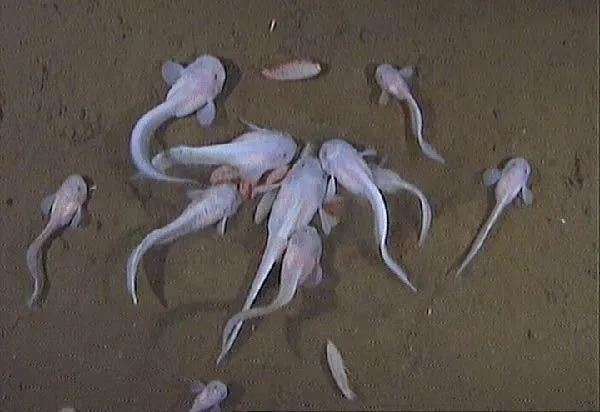
Marine biologists found between 10 and 20 snailfish writhing at 4.8 miles (7.7 km) below the ocean surface around a baited video lander in the Japan Trench, a 5.7-mile- (9-km-) deep gorge in the famous seismically and volcanically active Ring of Fire region in the Pacific Ocean. The number of fish may not seem like much, but because the research team could only film for five hours, they were surprised to find so many snailfish (Pseudoliparis amblystomopsis).
Scientists distinguished at least 10 individual fish and recorded their behavior, which was similar to the behavior of fish observed in 1965 from a bathyscaphe (submersible) at a depth of 4.5 miles (7.3 km) in the western Atlantic.
Today, the deep sea is still mysterious , because observations at such extreme depths five times farther down than the oil leak in the Gulf of Mexico are technically demanding and consequently rare. Because of the lack of observations, marine biologists do not know much about deep-sea fish, including how long they live and how they mingle with shallow-water fish.
"The current understanding of the hadal environment is inadequate," said study co-author Toyo Fujii of the University of Aberdeen in Scotland.
Previous records of fish supposedly captured at great depth are rare and mostly based on trawls, a technique that is subject to uncertainty about exactly when a fish entered the trawl net.
Sign up for the Live Science daily newsletter now
Get the world’s most fascinating discoveries delivered straight to your inbox.
The researchers for the new study recorded an illuminated patch of the seafloor for one minute every five minutes. The snailfish fed on crustaceans that were attracted to the mackerel bait on the camera.
A swarm of snailfish in the Japan Trench.
(Image credit: Toyonobu Fujii/University of Aberdeen.)
Hadal snailfish reside exclusively in deep trenches in the Pacific Ocean, at depths below 4 miles (nearly 7 km). There, they contend with total darkness, near freezing temperatures and water pressures equivalent to 1,600 elephants standing on the roof of a small car.
The new study is detailed in the July/August edition of the journal BioScience.
For the science geek in everyone, Live Science offers a fascinating window into the natural and technological world, delivering comprehensive and compelling news and analysis on everything from dinosaur discoveries, archaeological finds and amazing animals to health, innovation and wearable technology. We aim to empower and inspire our readers with the tools needed to understand the world and appreciate its everyday awe.