














Amazing Aurora Seen From Space

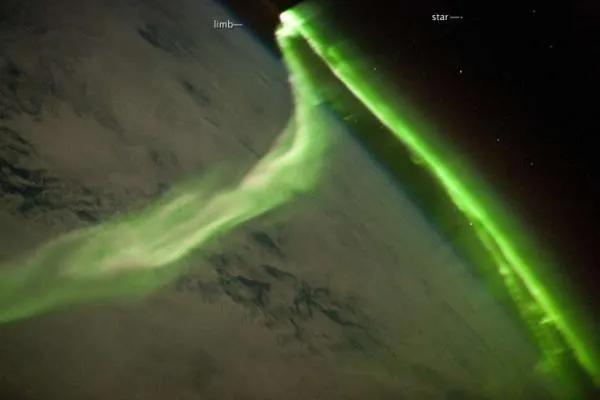
A spectacular display of Earth's southern auroras was captured on camera by astronauts on the International Space Station during a recent solar storm.
The dazzling aurora has a sinuous ribbon shape that separates into discrete spots near the lower right corner of the image. While the dominant coloration of the aurora is green, there are faint suggestions of red left of the photo's center.
Auroras ever-shifting displays of colored ribbons, curtains, rays, and spots are most visible near the north (aurora borealis) and south (aurora australis) poles as charged particles (called ions) streaming from the sun (the solar wind) interact with Earth's magnetic field.
While auroras are generally only visible close to the poles, severe magnetic storms impacting the Earth's magnetic field can shift them towards the equator. [More 2010 aurora photos.]
Astronauts caught this image of an aurora during a geomagnetic storm that was most likely caused by a coronal mass ejection from the sun on May 24, 2010.
The space station was sailing over the Southern Indian Ocean at an altitude of 220 miles (354 km) when this photo was taken by an astronaut most likely looking towards Antarctica (not visible) and the South Pole.
The curvature of the Earth's horizon (the limb) is clearly visible, as is the faint blue line of the upper atmosphere directly above it (at image top center). Several stars appear as bright pinpoints against the blackness of space at image top right.
Get the world’s most fascinating discoveries delivered straight to your inbox.
Auroras occur when ions in the solar wind collide with atoms of oxygen and nitrogen in the upper atmosphere. The atoms are excited by these collisions, and they typically emit light as they return to their original energy level. The light creates the aurora that we see.
The most commonly observed color of aurora is green, caused by light emitted by excited oxygen atoms.
This article was provided by SPACE.com, a sister site to OurAmazingPlanet.
