













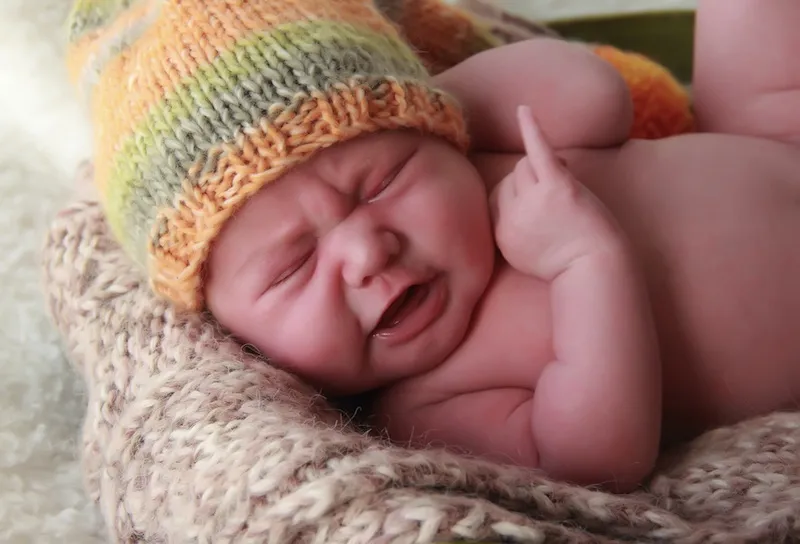
Dads are just as good as Moms at identifying their babies' unique cries, new research suggests.
The findings, published today (April 16) in the journal Nature Communications, suggest experience, not maternal instinct, leads to the better recognition.
"Before this study it was thought that mothers were more able to recognize their child from their cries than the fathers," said study co-author Nicolas Mathevon, a bioacoustician at Jean Monnet University in France. "Fathers are as good as mothers at this task and it's just a matter of learning." [Father Tales: History's 12 Most Doting Dads]
Animal cries
It's not clear that being able to distinguish one baby's cry from another is important for humans.
"We are not like penguins with children lost among hundreds of others that we have to recognize," Mathevon told LiveScience.
Still, being able to pick their baby's cries from others could mean a parent is better able to identify other needs, such as hunger or pain, from the teary wails, Mathevon said.
Get the world’s most fascinating discoveries delivered straight to your inbox.
Past studies suggested that women were in general better than men at this task, and some researchers still hold the view that a "maternal instinct" rooted at least partly in genetics could explain this difference. Still other research suggested baby cries boost the macho hormone testosterone in men, something that may trigger "I will protect you" behaviors.
That's my baby
To see how men and women differed on the task, the group recorded baby cries in two locations — France and the Democratic Republic of Congo. They then asked 27 fathers and 29 mothers to pick their babies cries out from four other babies.
On average, parents were able to pick out their babies' cries about 90 percent of the time.
Men could pick out their little ones' cries just as well as women — provided they spent at least four hours a day with the babies. Men who spent less time with their babies performed significantly worse at the task. The ability to pick out their babies didn't differ cross-culturally or with the baby's sex.
In follow-up work, Mathevon's team also showed that women who spent less than four hours per day with their tots also performed worse at the cry-recognition task, suggesting that experience, not instinct, honed this ability.
Cooperative breeders
The findings buttress the notion that humans evolved to be cooperative breeders, with not just mothers, but fathers, siblings, aunts and uncles all lending a hand to raise children, Mathevon said. As a result, everyone — not just women — would need the ability to care for a child.
"There's an African saying that you need a village to raise a child, and I think it's well in line with that," Mathevon said.
As follow-up work, Mathevon wants to see if men and women differ in their ability to pick out specific needs, such as hunger or discomfort, in their babies' cries.
Follow Tia Ghose on Twitter @tiaghose. Follow LiveScience @livescience, Facebook & Google+. Original article on LiveScience.com.

Tia is the editor-in-chief (premium) and was formerly managing editor and senior writer for Live Science. Her work has appeared in Scientific American, Wired.com, Science News and other outlets. She holds a master's degree in bioengineering from the University of Washington, a graduate certificate in science writing from UC Santa Cruz and a bachelor's degree in mechanical engineering from the University of Texas at Austin. Tia was part of a team at the Milwaukee Journal Sentinel that published the Empty Cradles series on preterm births, which won multiple awards, including the 2012 Casey Medal for Meritorious Journalism.