














Old Faithful's Underground Cavern Discovered

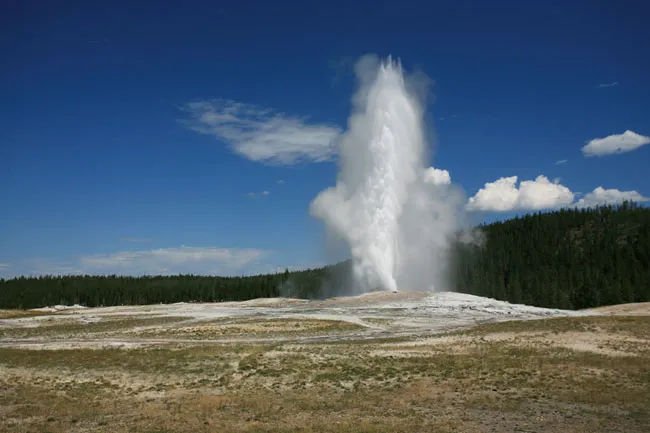
Old Faithful's underground plumbing looks more like a bagpipe than a flute, a new study of the Yellowstone National Park geyser finds.
A big chamber sits about 50 feet (15 meters) underground, located southwest of Old Faithful, researchers report in a study published online March 30 in the journal Geophysical Research Letters. The exact size can't be determined, but they estimate the egg-shaped void is at least 50 feet (15 m) tall and 60 feet (18 m) wide. The cavern connects to a pipe angled about 24 degrees that feeds Old Faithful's maw.
Tiny tremors extracted from seismic records collected in the 1990s revealed the shape of the cavern and geyser conduit. Popping gas bubbles create the tremors. Not only do the tremors map the shape of underground spaces, they can also track water. For the first time, scientists have a clear view of how Old Faithful works underground.
"We're able to locate with one- to two-meter precision the place where the boiling occurs," said Jean Vandemeulebrouck, a geophysicist at the University of Savoie in France. "We can see the water rising in the conduit."
How Old Faithful works
Old Faithful earned its name for its regular eruptions, which average every 92 minutes.
Just after an eruption, there's a 15-minute recharge period with low water levels. Then for about 50 minutes, water levels rise and seismic activity increases. The chamber never empties, but as steam bubbles fill the chamber, they can oscillate water in the conduit, eventually leading to a violent steam explosion. The bubble trap is what helps Old Faithful splash with smaller eruptions before fully blowing its top.
Get the world’s most fascinating discoveries delivered straight to your inbox.
The research is another nail in the coffin for the long-standing idea that big geysers erupt from long, narrow tubes. Earlier this year, researchers working in Kamchatka's Valley of the Geysers showed the Russian geysers also erupted from conduits fed by caverns. As with Old Faithful, the geysers explode because of underground bubble traps.
Geysers are rare features — only about 1,000 exist around the world. To form a geyser, there must abundant groundwater, a volcanic heat source to warm the water, open spaces so the water can escape and a way to trap bubbles.
Vandemeulebrouck is now collaborating with the U.S. Geological Survey to study another Yellowstone National Park geyser, called Lone Star. Their preliminary results are similar to Old Faithful, he said. [Video: A Scenic Tour of Yellowstone National Park]
"I think this oscillating system is quite common in geysers," Vandemeulebrouck told OurAmazingPlanet.
Email Becky Oskin or follow her @beckyoskin. Follow us @OAPlanet, Facebook or Google+. Original article on LiveScience's OurAmazingPlanet.
