













Antimatter's Magnetic Charge Revealed

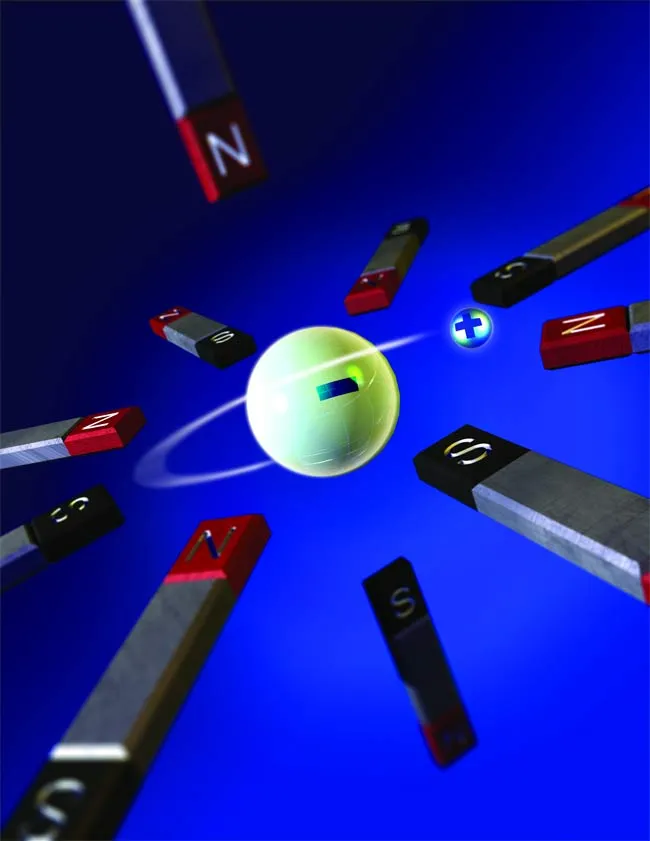
Scientists say they've made the most precise measurements to date of the magnetic charge of single particles of matter and its spooky counterpart antimatter.
A better understanding of the characteristics of these particles could help scientists solve one of the most baffling mysteries in physics: Why is the universe made of matter and not antimatter?
"According to our theories, the same amount of matter and antimatter was produced during the Big Bang," Harvard physicist Gerald Gabrielse explained in a statement. "When matter and antimatter meet, they are annihilated. As the universe cools down, the big mystery is: Why didn't all the matter find the antimatter and annihilate all of both? There's a lot of matter and no antimatter left, and we don't know why."
Gabrielse and his team captured individual protons and antiprotons in a trap created by electromagnetic fields that keep these particles suspended in one spot for several minutes, ensuring the two don't annihilate each other before measurements are made. For some of their experiments, the team turned to the extensive tunnels of the Geneva-based CERN (the European Organization for Nuclear Research) laboratory, where antiprotons can be created in high-energy collisions at the Large Hadron Collider (LHC).
Inside the LHC, protons zip at near light speed around a 17-mille-long (27 kilometers) underground loop on the border between France and Switzerland. Head-on particle collisions between protons can give rise to exotic particles, including the elusive Higgs boson, the particle theorized to explain how other particles get their mass. [LHC Photos: The World's Largest Atom Smasher]
By looking at the oscillations of the protons and antiprotons created, the scientists measured the size of the magnetic charge of both types of particles more accurately than ever before, boosting the precision of the antiproton measurement by a factor of 680.
"What we wanted to do with these experiments was to say, 'Let's take a simple system — a single proton and a single antiproton — and let's compare their predicted relationships, and see if our predictions are correct," Gabrielse said.
Get the world’s most fascinating discoveries delivered straight to your inbox.
Theory suggests that protons and antiprotons should be virtually identical in their mass and magnitude of charge but that they should have opposite charges. While the new measurements fit within this model, better measurements of protons and antiprotons could shed light on why matter came to dominate in the universe.
"What's also very exciting about this breakthrough is that it now prepares us to continue down this road," Gabrielse said. "I'm confident that, given this start, we're going to be able to increase the accuracy of these measurements by another factor of 1,000, or even 10,000."
The research was detailed March 25 in the journal Physical Review Letters.
Follow us @livescience, Facebook & Google+. Original article on LiveScience.com.
