














Amazing Image: Eerie Nightglow Over Texas

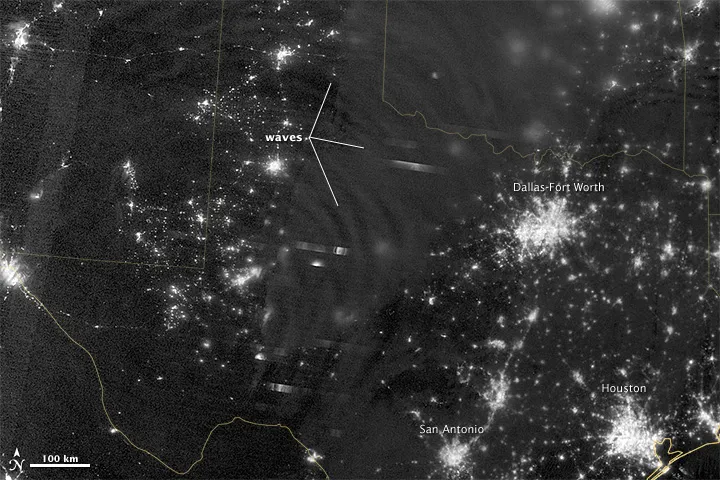
The moon and stars may hog all the glory, but they’re not the only light in the sky at night. The air itself glows from chemical reactions between oxygen and nitrogen and other molecules in the atmosphere.
The Suomi NPP satellite caught a massive thunderstorm making waves in the nightglow above Texas and Oklahoma on April 15, 2012. While nightglow is a well-known phenomenon, scientists were surprised at Suomi NPP's ability to detect it, according to NASA's Earth Observatory. During the satellite's check-out procedures, scientists thought this light source was a problem with the sensor until they realized that they were seeing the faintest light in the darkness of night, the Earth Observatory reported.
The strongest nightglow emissions occur between 53 and 60 miles (85 to 95 kilometers) above the Earth's surface, where enough molecules concentrate to release energy as light. Called chemiluminescense, the phenomenon is similar to the chemistry that lights up glow sticks or glow-in-the-dark stickers.
The day-night band of the Visible Infrared Imaging Radiometer Suite on the Suomi NPP satellite captured the glowing ripples. The day-night band detects lights over a range of wavelengths from green to near-infrared and can observe low-light signals. The absolute minimum detectable by the instrument is at the levels of nightglow emission.
Reach Becky Oskin at [email protected]. Follow her on Twitter @beckyoskin. Follow OurAmazingPlanet on Twitter @OAPlanet. We're also on Facebook and Google+.
Get the world’s most fascinating discoveries delivered straight to your inbox.
