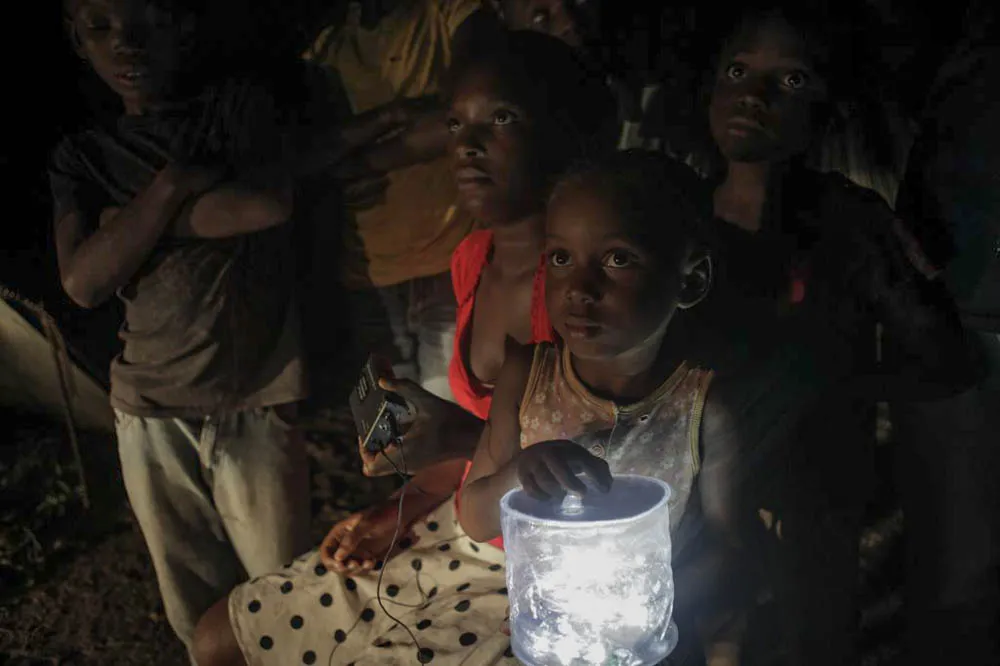
While a few days of power outage after Hurricane Sandy nearly crippled New York City, much of the world carries on in a permanent blackout: At least 1.3 billion people have no access to a power grid, according to the International Energy Agency. And many others can't count on 24/7 electricity service.
A New York City startup called Mpowerd is trying to change that — not with giant power plants, but with a little $16 combination solar-powered lamp, cellphone charger and Wi-Fi hotspot called Luci.
Luci looks like a cross between a flashlight and an inflatable pool toy. It starts out round and flat. Blowing into a valve on the top inflates it into a 5-inch-high clear cylinder, with a solar panel and a ring of 10 white LED lights that illuminate the cylinder from the bottom, making it about as bright as a 60-watt light bulb. When squished back down, Luci squeezes the light though a smaller opening, concentrating it more like a flashlight would.
The design makes Luci very light, at 4 ounces, and hard to kill. It can be dropped with no harm, and it even floats. "It's not something you want to go swimming with, but it can definitely survive a rain shower," said the inventor, Jason Alan Snyder.
Snyder hopes it will also be a hit in the U.S. and other rich countries, perhaps for camping or as an emergency light in a blackout. "It's wearable tech," he said, compressing the cylinder and holding it up to his shoulder. "You can strap it to you, and it charges all day. When the sun goes down, you can take it out and have a light."[See also: Prepare Your Tech for a Disaster]
When compressed, Luci takes up little space and also squeezes out a beam of light. When inflated, it can light a room.
(Image credit: Sean Captain)
The small solar panel takes six hours to charge the lithium-ion battery, which provides up to 12 hours of light. The battery functions for about a year, and Mpowerd is working on a program allowing people to return the solar panel and battery and receive a rebate. It's also experimenting with biodegradable plastic.
Sign up for the Live Science daily newsletter now
Get the world’s most fascinating discoveries delivered straight to your inbox.
While Mpowerd is out to help, it's also out to make money. The company will sell Luci for $15.99, not give it away. But it encourages customers to. As with the One Laptop Per Child program and Tom's Shoes, Mpowerd will offer a buy one/give one program. A customer can buy one light and also fund sending a second to a community in need, for a total of around $20 to $25.
The company is also hoping to provide them to international aid organizations (its communications director Jill van den Brule previously worked for UNICEF). Mpowerd is discussing deals with about a dozen organizations, said co-founder Steven Gundersen. The initial focus is on Africa, but Gundersen said they also want to bring Luci to Asia and Latin America.
Lights are just the beginning for Snyder. He is already working on adding a cellphone charger next year. Speaking of wireless, he also plans to add Wi-Fi, so that a bunch of Lucis are able to link up and form a mesh network. "I'm putting solar panels on both sides of them," said Snyder. "So you can just drop them … and walk away and have a network."
This story was provided by TechNewsDaily, a sister site to LiveScience.
A technology journalist since 2000, Seán has followed the tech world from the heady days of the consumer tech explosion and dotcom boom to the iPad, Facebook and beyond. Once an ueber-geek, Seán now focuses on making tech accessible to a broader audience than the nerdy fanbois. A former editor at PC World, Wired and Popular Science, he has also written for a wide array of publications, including The New York Times, The Wall Street Journal, Slate, Fast Company, Real Simple and Gizmodo. To find out what his latest project is, you can follow Seán on Google+.