














Stunning Cloud Swirls Spotted by Satellite

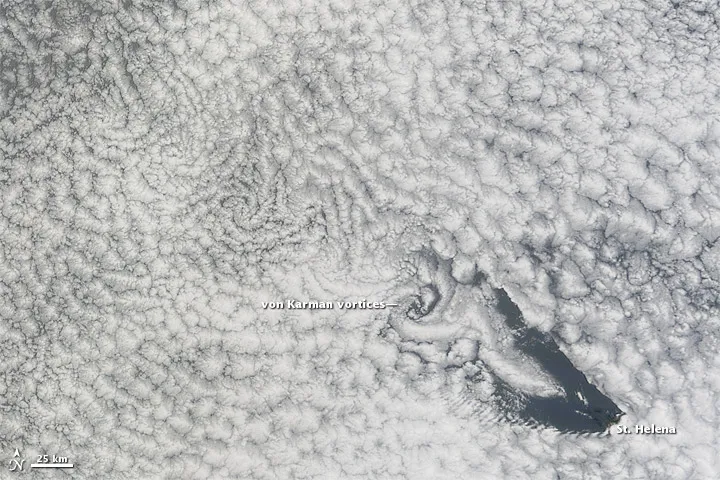
Alone in the South Atlantic Ocean sits the small volcanic island of Saint Helena. The towering peak of the island disrupts clouds as they pass overhead, creating swirling patterns called von Karman vortices that can be seen by satellites overhead.
The swirling clouds, moving to the northwest over Saint Helena, were snapped by NASA's Terra satellite on Nov. 15, 2012, according to NASA's Earth Observatory.
Von Karman vortices are created when a mass of fluid, such as water or air, encounters an obstacle, and creates swirls going in alternating directions. These so-called "Von Karman streets" can be seen in satellite photographs of clouds around the world, for example in this satellite image of the Pacific island of Guadalupe.
Saint Helena is dominated by Mount Actaeon, which reaches up to 2,680 feet (818 meters), according to the CIA World Fact Book. It's part of the British overseas territory that includes the islands of Ascension and Tristan da Cunha.
Nobody lived here when it was first discovered by the Portuguese in 1502. British soldiers were stationed on the island during the 17th century, according to the World Fact Book. It became well-known for being the place of Napoleon Bonaparte's exile from 1815 until his death in 1821, but its importance as a port went down after the opening of the Suez Canal in 1869.
Follow OurAmazingPlanet on Twitter @OAPlanet. We're also on Facebook and Google+.
Get the world’s most fascinating discoveries delivered straight to your inbox.
