













Giant Kites Take Flight in Italian Hill Country

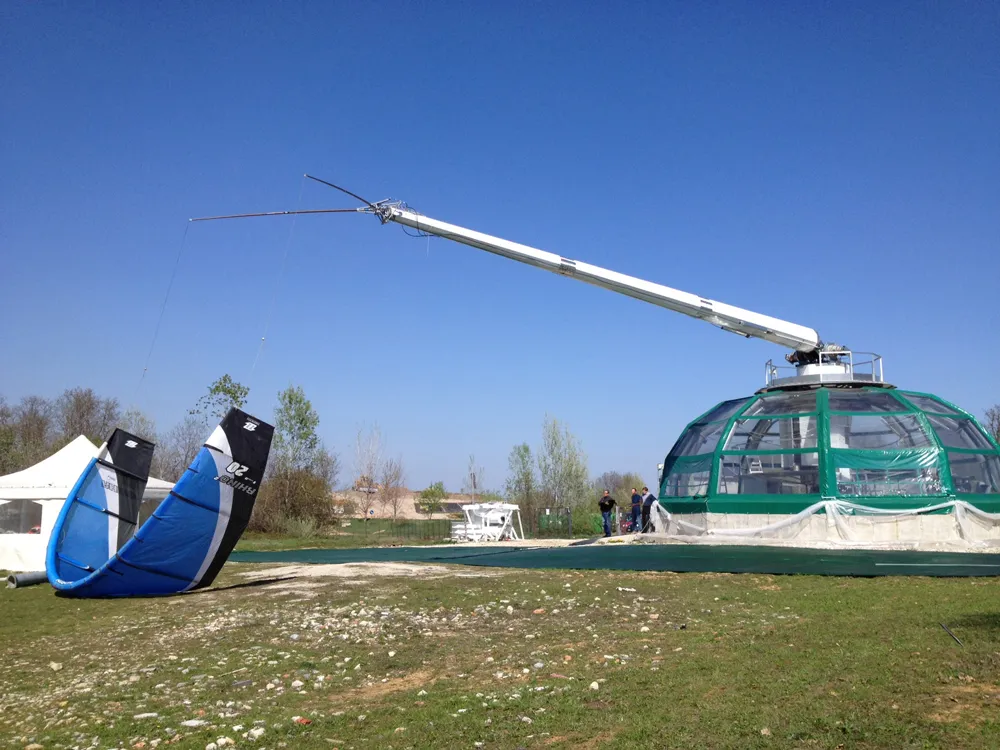
In the hills of northern Italy, one company is testing 540-square-foot kites made to fly a mile above the Earth. As the kites pull and jerk in winds twice as fast as winds on the ground, they produce emissions-free electricity. The kites' makers, Torino, Italy-based KiteGen Research, think their kites can one day compete with coal, oil and nuclear power, according to their website.
Several labs and companies have examined giant kites for green energy because kites reach higher-altitude winds that blow more strongly and steadily than winds near the surface of the Earth, Ken Caldeira, a climate and energy researcher at the Carnegie Institution for Science in Stanford, Calif., told InnovationNewsDaily sister site Livescience in 2009. Stronger, more constant winds translate to more energy harvested. Flying in jet stream winds six miles above the Earth, kites anchored to a square meter of ground could generate 30,000 watts of electricity, Caldeira told Ecomagination, an energy news website by GE. On the other hand, solar power generates an average of 300 watts of electricity per square meter.
Reaching the jet stream with kites is expensive and difficult, however. "It's a little bit like the fusion power of the renewable energy world, where it's not something that's practical economically today," Caldeira said. [5 Wild Weather Control Ideas]
Nevertheless, KiteGen Research hopes it can reach lower altitudes more cheaply, while still harvesting more energy than solar or wind turbine-generated technologies. Between half a mile and a mile above the Earth, winds should be twice as fast as on the Earth's surface, Massimo Ippolito, KiteGen's president and founder, told Ecomagination. (Jet stream winds blow 10 times as fast as surface winds.) The ratio of energy a huge kite would get back compared to the energy required to run it is 160 times greater than the same ratio for wind turbines, Ippolito said.
KiteGen has run several trials in Sommariva Perno, in the Piedmont region of Italy, at a location 1,312 feet above sea level. The company still needs to work on testing different fabrics for the kites, Ecomagination reported. It also needs to shore up the kites' equipment and sensors, which tend to break under the high energy of the winds they encounter. They're looking to raise an additional $62 million now, after earning $12 million in investment from the European Union and private investors.
Source: Ecomagination Check out previous coverage of KiteGen and related technology on InnovationNewsDaily sister site Livescience here and here.
This story was provided by InnovationNewsDaily, a sister site to LiveScience. Follow InnovationNewsDaily on Twitter @News_Innovation, or on Facebook.
Get the world’s most fascinating discoveries delivered straight to your inbox.
