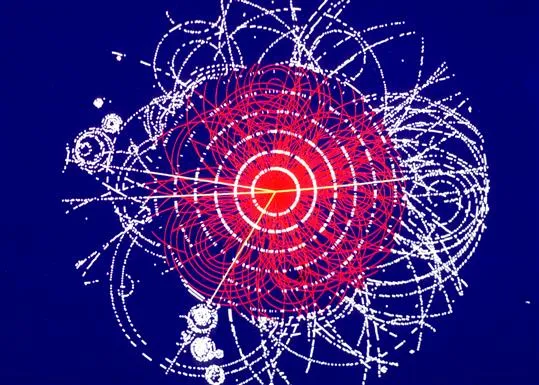
This track is an example of simulated data modelled for the ATLAS detector on the Large Hadron Collider (LHC) at CERN. The Higgs boson is produced in the collision of two protons at 14 TeV and quickly decays into four muons, a type of heavy electron that is not absorbed by the detector. The tracks of the muons are shown in yellow.
Physicists are thrilled at today's (July 4) announcement of the discovery of a new elementary particle that is likely the Higgs boson, an elusive particle thought to give all other matter its mass.
"To me it's really an incredible thing that it's happened in my lifetime," Peter Higgs, the leader of the group that first theorized the particle in 1964 and after whom the particle is named, said during a press conference Wednesday (July 4).
Evidence for the new particle was reported today by scientists from the world's largest atom smasher, the Large Hadron Collider in Switzerland. Researchers reported they'd seen a particle weighing roughly 125 times the mass of the proton, with a level of certainty that all but seals the deal it's the Higgs boson. The Higgs represents the last undiscovered particle predicted by the Standard Model, the reigning theory of particle physics.
Physicists involved in two experiments called CMS and ATLAS taking place at the world's largest particle accelerator, the Large Hadron Collider (LHC), reported evidence of the particle at a seminar and press briefing today.
"As a layman I would say 'We have it,' but as a scientist I would have to say 'What do we have?' We have discovered a boson and now we have to discover what kind of boson it is," CERN Director General Rolf Heuer said during the press briefing. [Top 5 Implications of Finding the Higgs Boson]
Even so, elation abounded with loud applause after the seminar talks.
Physicists at the CERN lab in Switzerland applaud news of the discovery of a new particle, likely the Higgs boson, July 4, 2012.
(Image credit: CERN)
"It is a momentous event and I am proud to be living in these historic times. Our 40-year quest for solving a puzzle is almost ending," Brown University professor of physics Meenakshi Narain told LiveScience. "Now we have to find out if this new particle really is the Higgs of the Standard Model or has properties which deviate from standard expectations and if there are other new particles to be discovered."
Sign up for the Live Science daily newsletter now
Get the world’s most fascinating discoveries delivered straight to your inbox.
Narain added in an email, "Our work is just beginning! It is a great leap for human kind and basic science."
"We have been propelled to the future of particle physics towards the understanding of the fundamental properties of our universe in its entirety," Caltech physicist Maria Spiropulu, who was in the audience at the LHC announcement, told LiveScience in an email.
Even Twitter was abuzz with terms such as #Higgs, #ICHEP2012, #CERN, Fabiola Gianotti and Joe Incandela (the names of the two scientists who presented the ATLAS and CMS findings, respectively) trending.
"5 sigma from CMS! Incredible!" tweeted @lirarandall, Harvard University theoretical physicist Lisa Randall, referring to results from two decay modes.
(To be certain they've made a true discovery and weren't just seeing a fluke, physicists need to reach a level of significance of 5 sigma, which means there is only a one in 3.5 million chance the signal isn't real. The ATLAS and CMS results reached sigma levels of 5 and 4.9, respectively.)
"The world might not change but my world (and that of a few others) certainly has," Randall tweeted.
"This is a crucial first step in understanding mass and gravity. We have a long, long way to go. But wow, what a step. #Higgs," tweeted @BadAstronomer Phil Plait, astronomer and author.
"We find it. WE FIND IT. Now I can cry #Higgs #Discovery," tweeted @marcodelmastro, Marco Delmastro, LHC physicist and ATLAS researcher.
Jeanna Bryner is managing editor of Scientific American. Previously she was editor in chief of Live Science and, prior to that, an editor at Scholastic's Science World magazine. Bryner has an English degree from Salisbury University, a master's degree in biogeochemistry and environmental sciences from the University of Maryland and a graduate science journalism degree from New York University. She has worked as a biologist in Florida, where she monitored wetlands and did field surveys for endangered species, including the gorgeous Florida Scrub Jay. She also received an ocean sciences journalism fellowship from the Woods Hole Oceanographic Institution. She is a firm believer that science is for everyone and that just about everything can be viewed through the lens of science.