















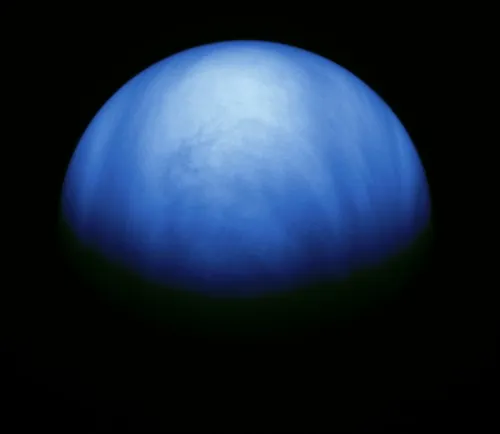
There is no question that countless numbers of people will be watching the transit of Venus on Tuesday; a very striking celestial phenomenon that has been seen only once in the last 129 years and won't happen again until December in the year 2117.
But as we prepare to watch the planet cross the face of the sun from our Earthly vantage point, have you ever wondered what the view would be like if we were on Venus? Obviously, that answer would be "what view?" since Venus is cloaked with a perpetual overcast.
But if it were somehow possible to get a view of the night sky from Venus right now, there would appear a uniquely stunning sight: our home planet Earth.
Flammarion's dream
During the late 19th and early 20th centuries, one of the most popular astronomy writers was Frenchman Nicolas Camille Flammarion. He was a prolific author of more than fifty books, as well as also publishing the magazine L'Astronomie, starting in 1882, as well as maintaining his own observatory at Juvisy-sur-Orge, France. In his 1894 book "Popular Astronomy," Flammarion speculated about the possibility of life on Venus. Then he added:
"The inhabitants of Venus see us shining in their sky like a magnificent star of the first magnitude, soaring in the zodiac, and showing motions similar to those which the planet Mars presents to us."
In fact, the view would be even more magnificent than Flammarion could have ever imagined. [Transit of Venus: A 2012 Observer's Guide (Infographic)]
Get the world’s most fascinating discoveries delivered straight to your inbox.
Stupendous blue-white star
From Earth, Venus would be at inferior conjunction, passing directly between us and the sun. But as seen from Venus, our Earth would be at opposition to the sun and interestingly, any Venusians looking Earthward would see (assuming they were above the planet's clouds, perhaps riding in a balloon) an object far brighter than any of the neighboring stars.
Viewed from Venus, the Earth would blaze like some stupendously bright bluish-white star in the constellation of Ophiuchus, the serpent holder. Our home planet would appear to blaze at a resplendent magnitude of -6.5. That's nearly five times brighter than Venus would appear for us!
Remember of course, that from Earth, Venus appears most dazzling when it's roughly one-quarter illuminated; a crescent shape seen at a distance of about 40 million miles (64 million km). But right now as seen from Venus, Earth is not a crescent but a fully illuminated disk. In addition, our two worlds are now at their closest proximity to each other, at 26.9 million miles (43.2 million km), making the "full Earth" appear about 1.75 times larger than the crescent Venus.
And furthermore, Earth would really would look like the "double planet" that science writers often proclaim it to be, for as seen from Venus, our moon shines like a yellowish-white star of magnitude -2.5 (about the same brightness as Jupiter would look to us) hovering within half a degree to the left of the Earth. As Flammarion noted, "they form a magnificent couple."
There's something for you to dwell upon as you watch the silhouette of Venus slowly cross in front of the sun on Tuesday.
Editor's note: If you snap a great photo of the Venus transit and would like to share it with SPACE.com for a story or gallery, please send images and comments to SPACE.com managing editor Tariq Malik at [email protected].
This story was provided by SPACE.com, a sister site to LiveScience. Joe Rao serves as an instructor and guest lecturer at New York's Hayden Planetarium. He writes about astronomy for The New York Times and other publications, and he is also an on-camera meteorologist for News 12 Westchester, N.Y.
