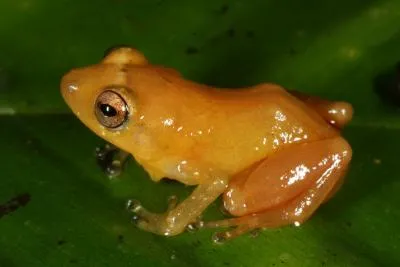
A new bright yellow frog species has been found in the mountains of western Panama.
The frog belongs to a species-rich group of frogs, the so-called rainfrogs that lack a tadpole stage, but develop directly as little frogs inside the egg.
Andreas Hertz and colleagues from the Senckenberg Research Institute in Germany discovered the frog in 2010. The frog measures less than 0.8 inches (2 centimeters) and lives in the Serranía de Tabasará of western Panama, a highly understudied part of the Panamanian central mountain range.
This is a yellow dyer rain frog while calling, with the air sacs exposed.
(Image credit: Andreas Hertz)
It also has a unique calls, which the researchers could hear before they discovered the bright little frog.
"Although we recognized that the male mating call of this species differs from all what we had heard before and therefore suspected it to be new, much effort was involved to finally spot it in the dense vegetation," Hertz said in a statement. "When we finally caught the first individuals by hand, we noticed that it dyes one's fingers yellow when it is handled. The scientific name (Diasporus citrinobapheus) of this new frog refers to this characteristic and means yellow dyer rainfrog."
To assure the validity of the frog as a new species, the biologists studied body structure, coloration, molecular genetic data, and vocalizations of a series of individuals, and compared the results with the data derived from closely related species.
Additionally, the researchers took into consideration the possibility that the yellow stain may be poisonous and performed an analysis of skin secretions.
Sign up for the Live Science daily newsletter now
Get the world’s most fascinating discoveries delivered straight to your inbox.
"We cannot say whether the dye is any good as a predatory defense, as we could not find any poisonous components," Hertz said. "Maybe the color is just easily washed out and has no particular function. However, for now, this peculiarity of the new species remains enigmatic."
The analysis of the new frog was published today, May 21 in the journal ZooKeys.
For the science geek in everyone, Live Science offers a fascinating window into the natural and technological world, delivering comprehensive and compelling news and analysis on everything from dinosaur discoveries, archaeological finds and amazing animals to health, innovation and wearable technology. We aim to empower and inspire our readers with the tools needed to understand the world and appreciate its everyday awe.