













Huge Atom Smasher Reaches Highest Energy Levels Yet

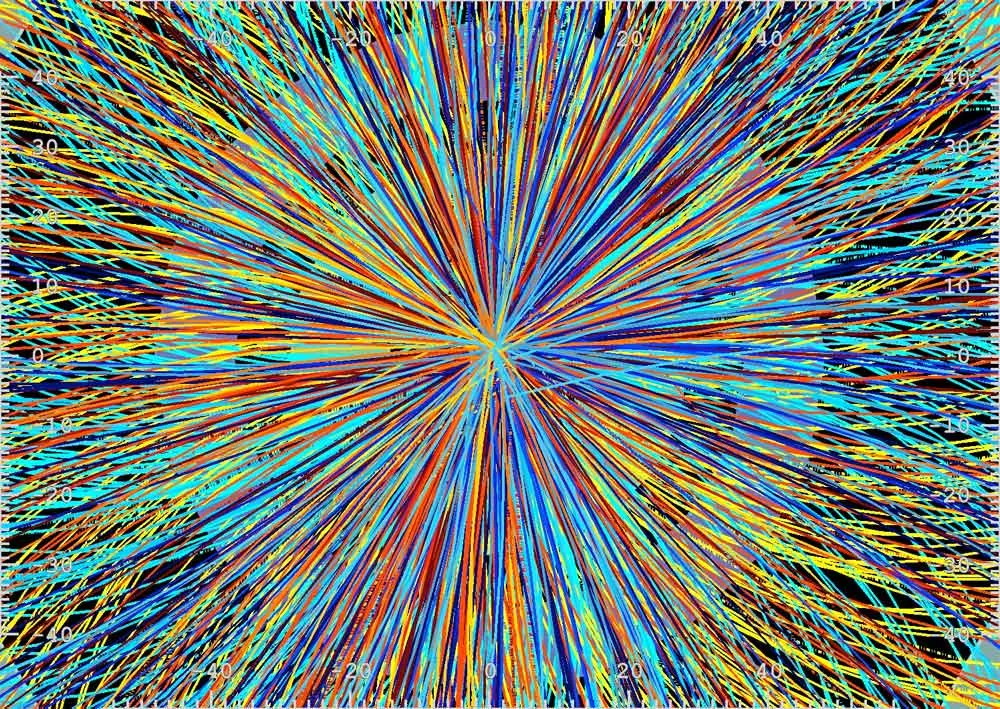
The world's largest particle accelerator has ramped up particles to higher energies than ever before, scientists announced Monday (March 19).
The Large Hadron Collider (LHC) is a 17-mile-long (27 kilometer) underground ring near Geneva, Switzerland, where protons are sped up to near the speed of light and then slammed into each other. The faster the particles go, the more energy they have.
In recent tests, LHC achieved energies of 4 teraelectron volts (TeV), a significant improvement over its current record of 3.5 TeV. Ultimately the machine, the most powerful of its kind, is designed to accelerate particles to 7 TeV, though to reach those energies, scientists are planning to shut down LHC for a refurbishment in late 2012.
After the successful tests, LHC will likely run particle collisions at 4 TeV starting in early April, officials said.
"Increasing the energy at which particles in the LHC collide allows physicists to probe new areas of physics," LHC officials wrote in a statement.
When particles collide inside the machine, they dissolve, converting their energy into new, sometimes exotic, particles. As Einstein's equation E=mc^2 tells us, energy can be converted into mass, and vice versa. Thus, the more energy the colliding particles have, the greater mass the resultant new particles may contain.
This is important because scientists are hoping to create never-before-seen particles inside the accelerator, such as the theoretical Higgs boson particle. According to the Standard Model, a theory that explains the workings of subatomic particles, the Higgs particle explains why all particles have mass; however, it has yet to be detected.
Get the world’s most fascinating discoveries delivered straight to your inbox.
So far, the LHC and other accelerators have seen tantalizing hints that the Higgs is being created by these collisions, but not firm proof. With higher-energy collisions, researchers boost the chances that a rare particle like the Higgs will be created, and detected.
"By the time the LHC goes into its first long stop at the end of this year, we will either know that a Higgs particle exists or have ruled out the existence of a Standard Model Higgs," said Sergio Bertolucci, research director of LHC's home laboratory, CERN. "Either would be a major advance in our exploration of nature, bringing us closer to understanding how the fundamental particles acquire their mass, and marking the beginning of a new chapter in particle physics."
Follow LiveScience for the latest in science news and discoveries on Twitter @livescience and on Facebook.
