Three scientists have won the Nobel Prize in Physics for their discovery that the universe is not just expanding but also picking up speed as it balloons, rather than slowing down, the Royal Swedish Academy of Sciences announced Tuesday (Oct. 4).
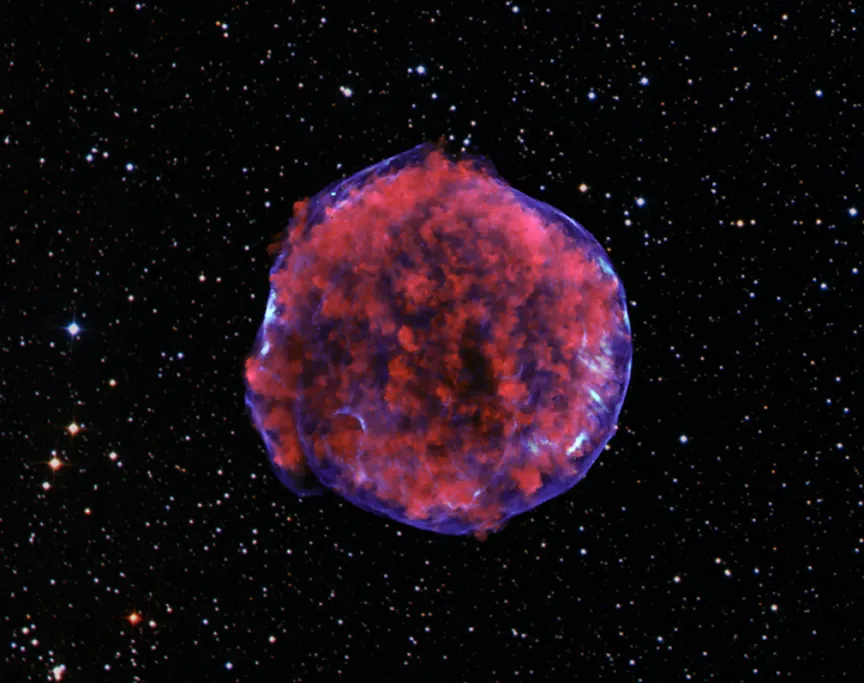
Two teams, one headed by Saul Perlmutter of Lawrence Berkeley National Laboratory and University of California, Berkeley, and the other by Brian Schmidt of the Australian National University and Adam Riess of Johns Hopkins University and Space Telescope Science Institute, had set to work to map the universe by locating the most distant supernovas. They focused on so-called type Ia supernova, an explosion of an old compact star as hefty as the sun but as small as the Earth. The teams ultimately found 50 distant supernovas whose light was weaker than expected, meaning they were farther away than they should have been -- a sign that the expansion of the universe was accelerating. [What Is a Supernova?]
Both teams announced their discoveries in 1998. "We expected to see the universe slowing down, but instead, all the data fit a universe that is speeding up," Riess said in 1998 while still a Miller Postdoctoral Research Fellow at UC Berkeley.
Latest Videos FromLive Science
Since then, the discovery has been bolstered by independent measurements, with the earliest and most significant such confirmations coming from the Millimeter Anisotropy eXperiment IMaging Array (MAXIMA), a balloon-borne experiment led by UC Berkeley physicist Paul Richards, and the Balloon Observations Of Millimetric Extragalactic Radiation and Geophysics (BOOMERanG) experiment, led by the late Andrew Lange, a former UC Berkeley post-doctoral fellow, and Paolo De Bernardis.
In addition to overturning a cosmological theory, their discoveries suggest that the expansion of the universe will continue to speed up until, in the distant future, hot stars are so far apart the universe will be a cold and dark place.
To explain the surprising find, scientists came up with the enigmatic force called dark energy, which is thought to counteract gravity that pulls the universe inward. To date, astronomers have yet to detect dark energy. In fact, recently, Perlmutter has been working with NASA and the U.S. Department of Energy to build and launch the first space-based observatory designed specifically to understand the nature of dark energy.