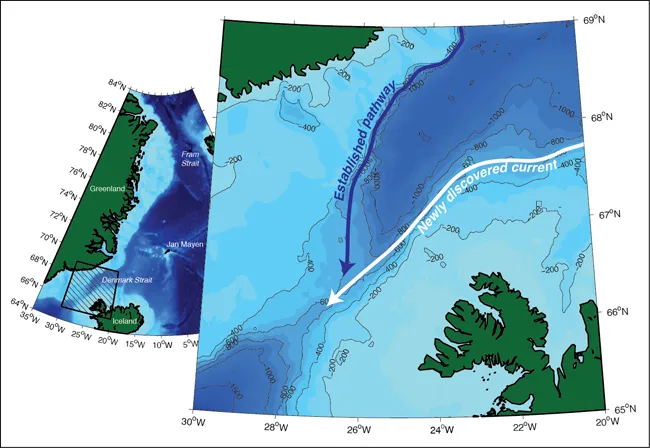
A hidden ocean current, discovered far below the sea's surface near Iceland, could be a major player in the ocean's response to climate change, a new study suggests.
The current, called the North Icelandic Jet, contributes to a key component of a circulation pattern known as the "great ocean conveyor belt." This circulation pattern transports warm surface water to high latitudes where the water warms the air, then cools, sinks and returns toward the equator as a deep, cold water flow.
The Icelandic Jet was found to be not only a major contributor to the conveyor belt, but the major source of the ocean's densest, coldest water.
"We've identified a new paradigm" that has "important ramifications" for the ocean circulation's impact on the climate, said study team member Robert Pickart of the Woods Hole Oceanographic Institution in Massachusetts.
The research vessel Knorr navigates the Iceland Sea while taking measurements of the Jet.
(Image credit: WHOI)
Scientists have been concerned that the giant conveyor belt is slowing down due to global warming. As Arctic sea ice vanishes, more fresh water is predicted to flow into the northern North Atlantic, where it could freeze and decrease the need for the conveyor belt to deliver as much warm water as it does now. If the conveyor belt slows down enough, the Northern Hemisphere could become colder in the future.
But that might not happen if the North Icelandic Jet is as big a contributor to the overall ocean flow as the study suggests.
To further investigate the new current, a team of scientists from the United States, Iceland, Norway and the Netherlands are scheduled to embark today (Aug. 22) on a cruise aboard the research vessel Knorr. The cruise will be chronicled at the North Icelandic Jet Cruise website.
Sign up for the Live Science daily newsletter now
Get the world’s most fascinating discoveries delivered straight to your inbox.
The study was published in yesterday's (Aug. 21) online issue of the journal Nature Geoscience.
For the science geek in everyone, Live Science offers a fascinating window into the natural and technological world, delivering comprehensive and compelling news and analysis on everything from dinosaur discoveries, archaeological finds and amazing animals to health, innovation and wearable technology. We aim to empower and inspire our readers with the tools needed to understand the world and appreciate its everyday awe.