













Light Bends Matter, Surprising Scientists

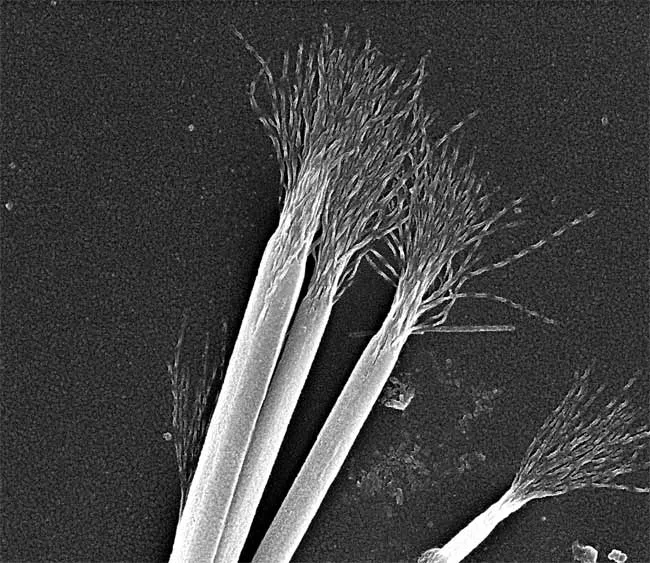
Light can twist matter, according to a new study that observed ribbons of nanoparticles twisting in response to light.
Scientists knew matter can cause light to bend – prisms and glasses prove this easily enough. But the reverse phenomenon was not shown to occur until recently.
The researchers assembled strings of nanoparticles, which are tiny clumps of matter on the scale of nanometers (one nanometer is one billionth of a meter). In a darkened lab, the scientists linked nanoparticles together into ribbons. At first the nano ribbons were flat, but when a light was shone on them, they curled up into spirals.
The discovery was so novel, the researchers were skeptical of their own results at first.
"I didn't believe it at the beginning," said lead researcher Nicholas Kotov, an engineer at the University of Michigan. "To be honest, it took us three and a half years to really figure out how photons of light can lead to such a remarkable change in rigid structures a thousand times bigger than molecules."
The surface of the nanoparticles in this experiment were made of cadmium sulfide. To begin with, they had a slightly negative electromagnetic charge. But when photons, or particles of light, hit the nanoparticles, their energy excited electrons on the nanoparticles, causing chemical reactions that made them even more negatively charged. Since two negative charges repel each other, the nanoparticles began to repel more strongly.
"What's happening is a layer of nanoparticles starts repulsing from the others, so it creates mechanical stress, and in order to release this stress the ribbon twists itself," Kotov told LiveScience. "It's very much like what's happening when you stretch a Christmas ribbon on a gift box and from the flat ribbon it becomes a spiral."
Get the world’s most fascinating discoveries delivered straight to your inbox.
This spiral structure, he said, is very important for optics and could lead to the development of new materials for a variety of technologies.
Kotov and his team detail their findings in the March 17 issue of the journal Science.
- Video - Nano Soccer
- World's Smallest Hot Rod Made Using Nanotechnology
- The Science of Nanotechnology
