













Shark 'Autopsy' Webcast: Science or Stunt?

Note: Scroll down to vote
Pity the poor museum these days, trying to draw customers in a lousy economy when people can just sit home and watch "CSI" shows or "Nip 'n' Tuck."
Oh, wait, we can cut things up, too!
The webcast done today of a great white shark necropsy, or animal autopsy, is apparently part of a growing trend of cutting creatures open to draw crowds.
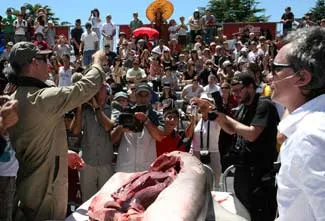
New Zealand researchers opened a partially frozen 10-foot (3 meter) great white shark in front of a local crowd of some 4,000 and an online audience said to number 30,000. The female shark had been entangled and killed in a gill net and recovered (legally) by the Department of Conservation in Auckland.
Camera-toting people in attendance passed by the sliced-and-diced animal in a long viewing line a safety wardens kept order. Children touched the shark's bloody snout.
In the shark's stomach the scientists found the remains of fish, a fishhook and some nylon wire. (Remember the scene in "Jaws," when Richard Dreyfuss cuts open the stomach of a shark? He found a crushed tin can and a license plate.)
Get the world’s most fascinating discoveries delivered straight to your inbox.
"This was a fantastic and rare opportunity to bring the public face-to-face with a great white, both to promote the conservation this magnificent and vulnerable species, and to further our knowledge of great white biology," said Auckland Museum's Marine Curator Tom Trnski.
Last year the Melbourne Museum held a public dissection of a giant squid. And a blog post today at the Te Papa museum in New Zealand said: "We have also had great success with making some recent scientific examinations and dissections available online."
The video of the dissection is available here (note: you'll have to wait several minutes to get through the prelude of the ceremony).
<script type="text/javascript" language="javascript" src="http://static.polldaddy.com/p/1257235.js"></script><noscript> <a href ="http://answers.polldaddy.com/poll/1257235/" >So, what do you think? Science or publicity stunt?</a> <br/> <span style="font-size:9px;"> (<a href ="http://www.polldaddy.com"> surveys</a>)</span></noscript>
- Gallery: Great White Sharks
- Great White Lies About Great White Sharks
- Sharks: News, Information and Images
Robert Roy Britt is the Editorial Director of Imaginova. In this column, The Water Cooler, he takes a daily look at what people are talking about in the world of science and beyond.

Robert is an independent health and science journalist and writer based in Phoenix, Arizona. He is a former editor-in-chief of Live Science with over 20 years of experience as a reporter and editor. He has worked on websites such as Space.com and Tom's Guide, and is a contributor on Medium, covering how we age and how to optimize the mind and body through time. He has a journalism degree from Humboldt State University in California.