













Italy Quakes: What Makes an Earthquake an Aftershock?

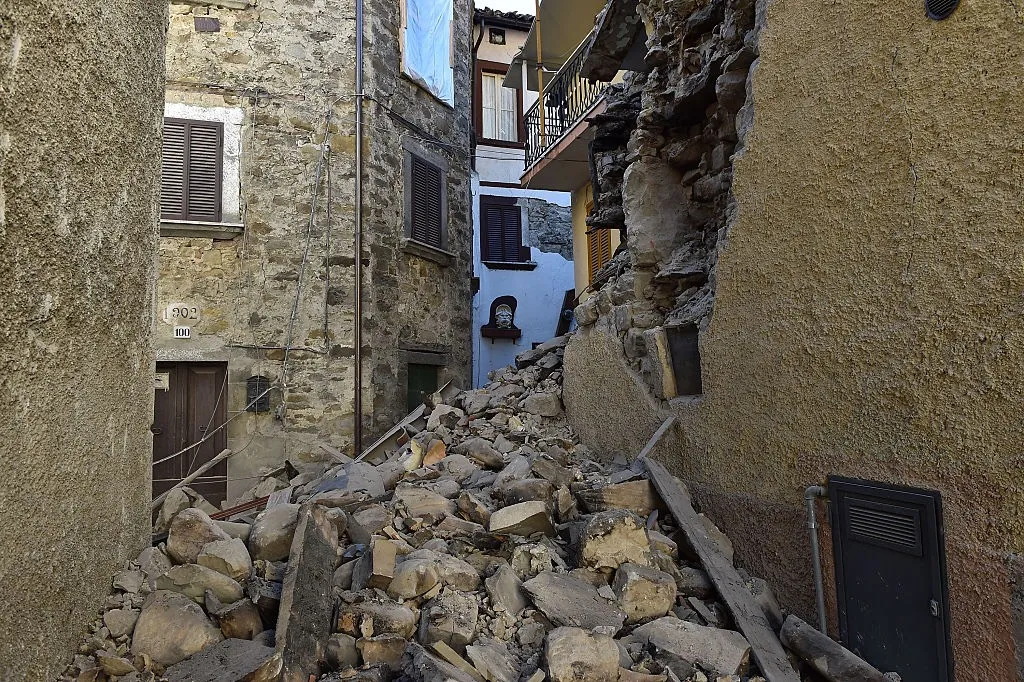
A magnitude-6.6 earthquake that rocked central Italy on Sunday (Oct. 30) was not only the strongest earthquake to strike the region in 36 years, but it was also the latest in a series of powerful tremors. Those originated Aug. 24, with a magnitude-6.2 temblor, and then ramped up again Oct. 26 with two formidable quakes.
And the shaking didn't end on Oct. 30. Following the earthquake, Italy's geophysics and volcanology institution Istituto Nazionale di Geofisica e Vulcanologia (INGV) reported 560 post-quake tremors, which are typically referred to as aftershocks.
While most aftershocks are minor, some can be as strong as the earthquake that preceded them. So, what distinguishes aftershocks from earthquakes, and how do geologists interpret these events to understand seismic activity in Italy and in other earthquake-prone regions worldwide? [The 10 Biggest Earthquakes in History]
Earthquakes typically happen in groups, and scientists use the terms earthquake and aftershock to describe when in the sequence a tremor occurred, said Michael L. Blanpied, the associate coordinator of the U.S. Geological Survey (USGS) Earthquake Hazards Program.
Seismologists refer to the biggest quake in a sequence as the "main shock," Blanpied told Live Science. Quakes that precede it are "foreshocks," and quakes that follow the main event are "aftershocks."
Sometimes, however, an aftershock emerges that is more powerful than the main shock that happened earlier.
"Then we shuffle around the names," Blanpied said. "We call the new biggest one the main shock. We call the earlier ones foreshocks, and the ones that come after it are aftershocks.
Get the world’s most fascinating discoveries delivered straight to your inbox.
"It's our way of sorting things out," he explained. "But they're all earthquakes."
Forecasting the swarm
In central Italy, earthquake sequences typically produce lots of tremors. "They tend to come in what we call swarms," Blanpied said. But it's hard for scientists to know if a cluster of aftershocks will produce a powerful event or simply peter out, he said.
"The rate of the earthquakes can rise or fall, and there may be more than one big one in the midst. Trying to forecast the future activity in such a swarm is extremely difficult," he said.
Geologically speaking, the faults that fuel Italy's quakes are young, only about 1 million years old. They run down the spine of the Apennine Mountains and are relatively small, so they can't generate massive quakes like those created by longer and older faults, such as the San Andreas in California.
"In mature faults, once an earthquake gets going, it can race along for long distances —that's where you can get the magnitude-7 to -8 quakes," Blanpied said. "In a more youthful, broken-up mélange of faults like we have in central Italy, one particular piece of fault may only be big enough to host a 5- to 6-magnitude earthquake."
Layers of stress
But in areas veined with shorter faults, like in central Italy, a quake can send a cascade of stresses into faults nearby, pushing them closer to the brink, when they would slip and trigger yet another earthquake, Blanpied said.
According to Blanpied, the recent tremors can be linked back to quakes that visited the region in August. As those faults triggered quakes, they also moved stress onto faults to the south, which are creating the big earthquakes now, Blanpied said. And these recent quakes could in turn shunt stress into more faults, potentially triggering even more earthquakes.
"What we don't know is if additional faults big enough to make magnitude-6 quakes will now be brought closer to failure," Blanpied said.
He explained that Italian seismologists are currently in the field, mapping fault ruptures and closely examining the locations of new earthquakes. The researchers are working to determine which faults have moved and by how much, and how that could increase the stress load in other faults, making them prone to quakes as well.
"We hope that the sequence will die off now," he added. "But we have to see. We have no way to predict that for sure."
Original article on Live Science.

Mindy Weisberger is a science journalist and author of "Rise of the Zombie Bugs: The Surprising Science of Parasitic Mind-Control" (Hopkins Press). She formerly edited for Scholastic and was a channel editor and senior writer for Live Science. She has reported on general science, covering climate change, paleontology, biology and space. Mindy studied film at Columbia University; prior to LS, she produced, wrote and directed media for the American Museum of Natural History in NYC. Her videos about dinosaurs, astrophysics, biodiversity and evolution appear in museums and science centers worldwide, earning awards such as the CINE Golden Eagle and the Communicator Award of Excellence. Her writing has also appeared in Scientific American, The Washington Post, How It Works Magazine and CNN.