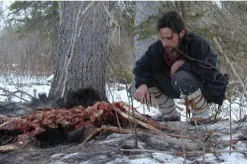
Editor's Note: ScienceLives is an occasional series that puts scientists under the microscope to find out what makes them tick. The series is a cooperation between the National Science Foundation and LiveScience.
Name: John A. Vucetich Age: 38, I think Institution: Michigan Technological University Field of Study: Much of my research is focused on population biology and the ecology of wolves and moose. All populations fluctuate over time, and I’m curious to know how and why.
John A. Vucetich of Michigan Technological University has long been an outspoken advocate for environmental policies that protect wildlife. He is co-author — with environmental ethicist Michael Nelson of Michigan State University — of much-cited essays on environmental ethics, the most recent titled "On Advocacy by Environmental Scinetists: What, Whether, Why, and How" and published in the journal Conservation Biology. Vucetich and Nelson also co-authored a letter to federal officials, signed by dozens of ecologists and environmental philosophers across the country, warning that pending changes to the endangered species act could substantially weaken its ability to protect certain animals. Vucetich's primary research is the well-known wolf-moose predator-prey study at Isle Royale National Park, the longest running predator-prey study in the world. Recent press releases about Vucetich and his work can be found here, here (a Michigan Tech news release about his essay "Abandon Hope") and here (about the Endangered Species Act protest letter). Below, Vucetich answers the ScienceLives 10 Questions. What inspired you to choose this field of study? I grew up in suburbia but was always trying to be outside in natural environments. From that time, I knew I wanted to work outside. In the fourth year of my undergrad experience, I took an advanced course in statistic. At that time, I knew that I wanted to do research that involved ecology and quantitative methods. What is the best piece of advice you ever received? Don’t be afraid of the truth. What was your first scientific experiment as a child? I don’t recall, but I suppose it involved trying to get something from my mother that she didn’t think I should have. What is your favorite thing about being a scientist or researcher? I spend a great deal of time being outside, writing, analyzing data, and sharing ecological knowledge with others. Diversity of work is what I like most about being a scientist. What is the most important characteristic a scientist must demonstrate in order to be an effective scientist? Fostering the creativity to identify good questions, questions that are not just curious, but also important; questions whose answers are interesting, no matter what the answer may be; and questions for which you have the resources to answer excellently. What are the societal benefits of your research? I hope the most valuable benefit of my research is to give people new reasons to be wondrous of the natural world around us. Who has had the most influence on your thinking as a researcher? Rolf Peterson (Michigan Technological University) taught me curiosity and patience, trusted me, and showed me the way; Thomas Waite (Ohio State University) taught me to think clearly. What about your field or being a scientist do you think would surprise people the most? How smelly and mundane it is to prepare bones from the carcasses of moose and wolves that we find. If you could only rescue one thing from your burning office or lab, what would it be? My laptop computer. What music do you play most often in your lab or car? My lab is the outdoors, where I listen to song birds. I don’t spend much time in the car, I usually walk or ride my bike to the university. The most played music on my iTunes include: Tom Waits, Josh Ritter and Nouvelle Vague.
Latest Videos From

 Live Science Plus