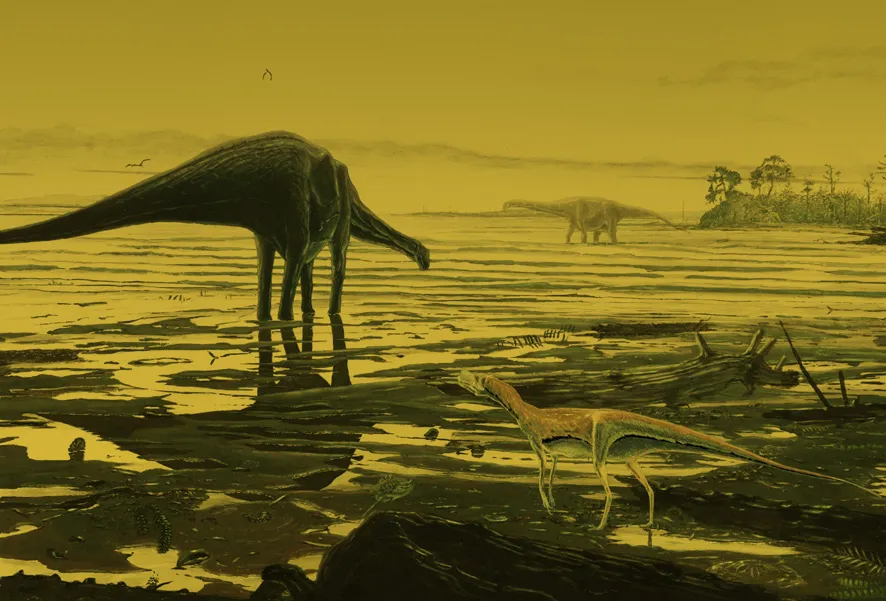
The giant footprints of long-necked sauropods were found on the rocky coast of the Isle of Skye in Scotland this past April. When the track marks were made about 170 million years ago, the dinosaurs were walking through a shallow saltwater lagoon, the researchers said. These Middle Jurassic prints suggest that the paleo-beasts didn't just walk on dry land, as was previously thought, but were comfortable walking in shallow water, the researchers said. [Read the full story on the sauropod hand and footprints]
Rocky coast
Paleontologists Steve Brusatte (right) and Tom Challands (left) stand near the dinosaur track marks on the Isle of Skye. (Photo credit: Mark Wilkinson)
Although this area on the Isle of Skye is well known to geologists, the 170-million-year-old track marks went unnoticed until this past April, likely because the prints were often covered by the tide as well as sand and seaweed. (Photo credit: Steve Brusatte)
Giant mark
This raised footprint formed over many millions of years. After the dinosaur left a depression with its foot on the bottom of the lagoon, the hole was filled with a hard type of rock. As the softer rock around it eroded away over geological time, a raised cast of the print remained. (Photo credit: Steve Brusatte)
Sign up for the Live Science daily newsletter now
Get the world’s most fascinating discoveries delivered straight to your inbox.
Lots of puddles
The ebb and flow of the tide on the Isle of Skye has eroded the sauropod footprints over time. (Photo credit: Steve Brusatte)
Middle Jurassic
An illustration of the long-necked sauropod dinosaurs that may have left their tracks in a Scottish lagoon about 170 million years ago. (Image credit: Jon Hoad)
Lagoon walk
Another cast of a sauropod track mark on the Isle of Skye. The prints make up the largest dinosaur site in Scotland and the first known sauropod trackway in the country. (Photo credit: Steve Brusatte)
Hand to foot
Paleontologists Steve Brusatte (left) and Tom Challands (right) pose with a cast of a sauropod track mark as the tide menaces from behind. (Photo credit: Mark Wilkinson)
Laura is the managing editor at Live Science. She also runs the archaeology section and the Life's Little Mysteries series. Her work has appeared in The New York Times, Scholastic, Popular Science and Spectrum, a site on autism research. She has won multiple awards from the Society of Professional Journalists and the Washington Newspaper Publishers Association for her reporting at a weekly newspaper near Seattle. Laura holds a bachelor's degree in English literature and psychology from Washington University in St. Louis and a master's degree in science writing from NYU.