













Animal Sex: How Ants Do It

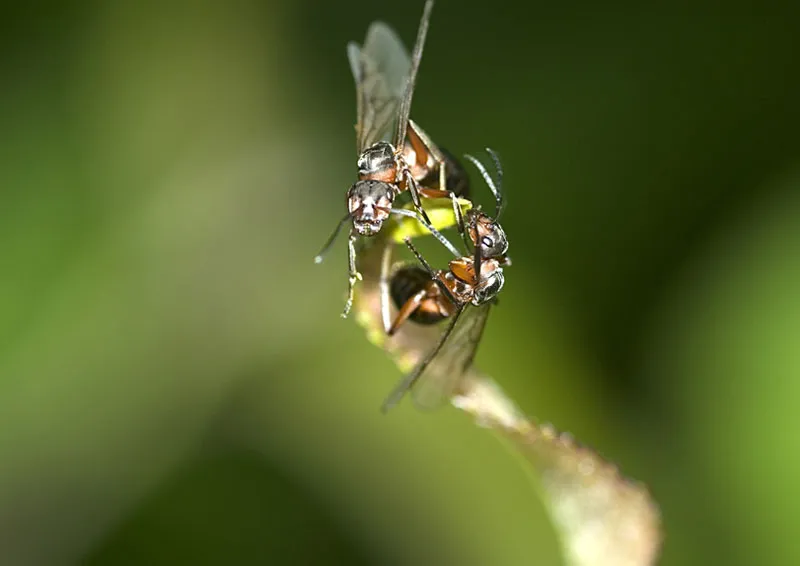
Ants are social insects belonging to the order Hymenoptera, which also includes wasps and bees. And though people typically don't think of ants as flying insects, ant sex is often a crowded, aerial event not so different from the mating flights of honeybees.
Ant society is divided into several castes, including workers, soldiers, drones and queens. Workers and soldiers are flightless females that take care of the colony. Drones, which develop from unfertilized eggs, are winged males born with the sole purpose of procreation. Breeding females can also fly — they become queens after mating, breaking off their wings and starting a new colony (or joining a multi-queen colony).
Two main "syndromes," or mating strategies, exist among the 20,000 ant species across the globe, explains Florida State University ant specialist Walter Tschinkel. During male-aggregation syndrome, drones swarm over conspicuous landmarks, such as hilltops and tall trees, and breeding females soon join them.
A pair mates (in the air) when a male inserts his aedeagus (analog of a penis) into a female's reproductive tract and deposits sperm. The sperm travels to the female's spermatheca, or sperm-storage receptacle; the female will use this singular batch of stored sperm to reproduce for the rest of her life. [The 7 Weirdest Animal Penises]
In some ants, such as fire ants, a female will only mate with one male before departing the "nuptial flight" to start a new colony. Harvester ants and other species will mate with five to 15 drones before calling it quits, Tschinkel told LiveScience.
During the less common female-calling syndrome, breeding females come up to the surface of their natal colonies and release pheromones to attract males for mating, which occurs on the ground.
In both syndromes, males often die shortly after mating.
Get the world’s most fascinating discoveries delivered straight to your inbox.
Follow LiveScience @livescience, Facebook & Google+.
