














Amazing Auroras

Green Aurora Iss
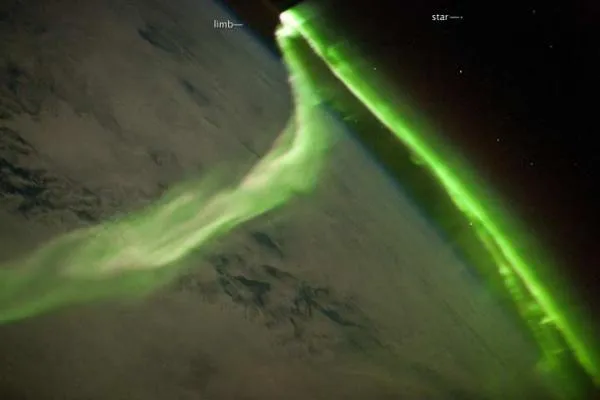
This snaking green aurora was the result of a geomagnetic storm that was most likely caused by a coronal mass ejection from the Sun on May 24, 2010.
Astronauts aboard the International Space Station captured this picture of the light show as they orbited over the Southern Indian Ocean at an altitude of 220 miles (350 kilometers), with the astronaut observer most likely looking towards Antarctica (not visible) and the South Pole.
The aurora has a sinuous ribbon shape that separates into discrete spots near the lower right corner of the image. While the dominant coloration of the aurora is green, the most commonly observed aurora color, there are faint suggestions of red left of image center.
Aurora Australis

From space, the aurora is a crown of light that circles each of Earth's poles.
NASA's IMAGE satellite captured this view of the aurora australis (southern lights) on Sept. 11, 2005, four days after a record-setting solar flare sent plasma an ionized gas of protons and electrons flying towards the Earth.
The ring of light that the solar storm generated over Antarctica glows green in the ultraviolet part of the spectrum, shown in this image. From the Earth's surface, the ring would appear as a curtain of light shimmering across the night sky.
Aurora Us

Astronauts aboard the International Space Station also got to observe an aurora on Oct. 4, 2001, as it glimmered in green over the United States.
Red Aurora

Red colors of the aurora are dominant in this image captured by ISS astronauts in September 2001.
Red auroras are caused by excitement and emission of light from different molecules in the atmosphere than green aurora, specifically, molecular oxygen and nitrogen.
The white spot in the image is from a light on the inside of the Station that is reflected off the inside of the window. The pale blue arch on the left side off the frame is sunlight reflecting of the atmospheric limb of the Earth.
Aurora City Lights

City lights weren't the only thing shining in the night sky on October 29, 2003. A spectacular display of the aurora borealis, or northern lights, blazed across a large swath of the Northern Hemisphere that night as a powerful solar storm buffeted the Earth with a wind of electrically charged particles.
Normally, these light spectacles are limited to very high latitudes, but when powerful solar storms occur, the aurora can creep down from the poles and can be visible across Europe and the United States.
In this image of part of eastern North America captured by the Defense Meteorological Satellite Program on the night of October 29, the bright white veil of the southward-dipping aurora is visible all across southern Canada and the northern United States.
Get the world’s most fascinating discoveries delivered straight to your inbox.
