













The Physics of the First-Ever Supersonic Skydive

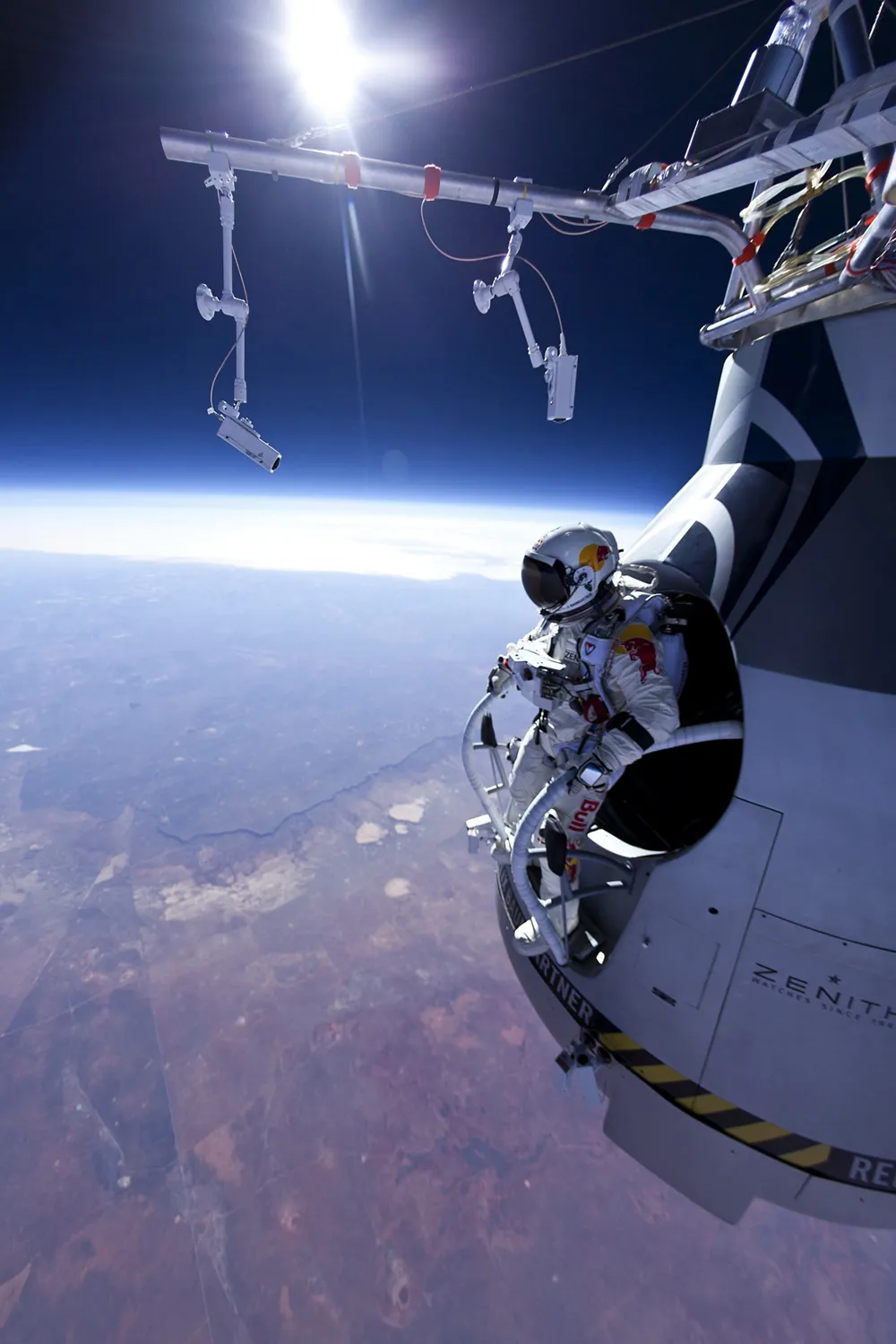
An Austrian daredevil is gearing up to make the world's highest skydive on Monday (Oct. 8), a high-flying leap from 23 miles above Earth that promises to break more than one record if all goes according to plan.
Veteran skydiver Felix Baumgartner, 43, will make the jump, thereby becoming the first person ever to freefall faster than the speed of sound. His skydive will also be the highest ever, superceding a record set in 1960 by U.S. Air Force Captain Joe Kittinger by more than 3 miles (5 kilometers).
But what's the physics of this situation?
A helium-filled balloon will lift Baumgartner, sitting inside a custom-built capsule, to an altitude of 120,000 feet (36,576 meters). At that altitude, which registers in the upper echelons of the stratosphere, the atmosphere is a mere inkling of its sea-level self, exerting a pressure less than 0.5 percent of its value near the ground. Even if gradually acclimated, humans cannot survive long above 26,000 feet without an oxygen tank, so a much loftier Baumgartner will definitely require supplemental oxygen.
When the skydiver steps out of his capsule and plunges into the void, he'll accelerate for approximately 30 seconds before reaching his peak speed, explained Michael Weissman, a physicist at the University of Illinois at Urbana-Champaign. Weissman estimates that Baumgartner's speed will max out just above the sea-level speed of sound, which is about 760 miles per hour (1,225 kilometers per hour).
Baumgartner stops accelerating because of collisions with air molecules. Called a "drag force," air resistance opposes a falling body's downward motion, counteracting the downward force of gravity by pushing the body upward. The faster the body falls, the greater the air resistance it experiences, and so at a certain maximum velocity, called the terminal velocity, the drag force becomes equal and opposite to the gravitational force. With the two forces balanced, the body no longer accelerates.
Under normal circumstances, reaching terminal velocity means one's speed subsequently stays constant, but that's only true when external forces remain constant. In the case of this skydive, explains the physicist Louis Bloomfield of the University of Virginia, the surrounding atmosphere thickens dramatically as Baumgartner falls, so the upward drag force exerted on him by the air steadily increases. Consequently, the local terminal velocity drops as his altitude drops. [Infographic: Earth's Atmosphere Top to Bottom]
Get the world’s most fascinating discoveries delivered straight to your inbox.
"As he descends, the local terminal velocity will decrease and so he will slow down gradually until he reaches the 100-200 mph of near-sea level skydiving," Bloomfield told Life's Little Mysteries.
At that point, Baumgartner enters safe waters: The fall turns into an ordinary skydive. But what will happen to his body before that point, as he plunges through the stratosphere at the speed of sound?
For one thing, according to Bloomfield, a shock wave, also known as a sonic boom, will envelop his body. "He'll be colliding with the gas so fast that it can't flow out of his way because it effectively doesn't know that he's coming," he said. [Can You See a Sonic Boom?]
Secondly, those high-speed collisions with the air will generate a huge amount of heat.
"When he's near the maximum speed, almost all the gravitational potential energy he loses [from] falling gets converted to heat," Weissman said. If he and his suit together weigh in the neighborhood of 220 pounds (110 kilograms), he'll produce around 300 kilowatts of heat when falling at sonic speeds.
"If that heat was simply dumped into the skydiver, he'd heat almost 1 degree Celsius [1.8 degrees Fahrenheit] per second, which would be rapidly fatal," he said. "Of course most of that heat goes into the atmosphere, but it doesn't sound like a good idea to be around the equivalent of 200 high-power hairdryers for very long without some protection."
Assuming Baumgartner's suit offers the protection he needs, he should survive the fall. But Weissman pointed out that the very act of making that assumption suggests this stunt is dangerous. "As a general rule I'd say that anything extreme and unprecedented has special dangers," he said. "In this case the long period reliant on oxygen and heat protection from the suit raises issues not faced by an ordinary skydiver. In other words, there's more 'assuming' required here."
If Baumgartner is worried at all, he's not showing it. "I feel like a tiger in a cage waiting to get out," he said in a statement.
This story was provided by Life's Little Mysteries, a sister site to LiveScience. Follow Natalie Wolchover on Twitter @nattyover or Life's Little Mysteries @llmysteries. We're also on Facebook & Google+.

Natalie Wolchover was a staff writer for Live Science from 2010 to 2012 and is currently a senior physics writer and editor for Quanta Magazine. She holds a bachelor's degree in physics from Tufts University and has studied physics at the University of California, Berkeley. Along with the staff of Quanta, Wolchover won the 2022 Pulitzer Prize for explanatory writing for her work on the building of the James Webb Space Telescope. Her work has also appeared in the The Best American Science and Nature Writing and The Best Writing on Mathematics, Nature, The New Yorker and Popular Science. She was the 2016 winner of the Evert Clark/Seth Payne Award, an annual prize for young science journalists, as well as the winner of the 2017 Science Communication Award for the American Institute of Physics.