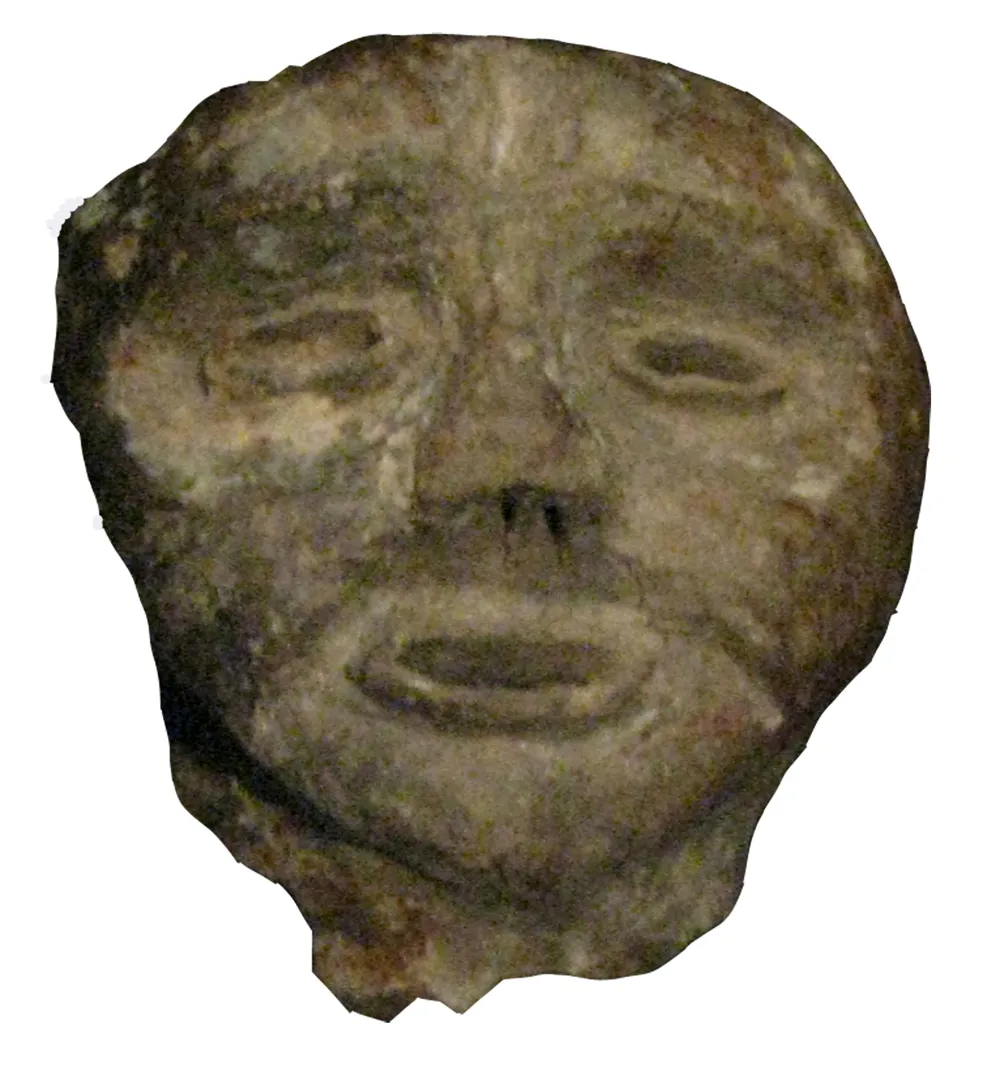
A human pipe effigy, it appears to offer a tantalizing glimpse at the faces of the people of the site. At the Mantle site archaeologists have discovered 200,000 artifacts, LiveScience takes a look at a selection of them in this photo gallery.
Another human face
(Image credit: Owen Jarus)
This selection also offers a tantalizing glimpse at the faces of the people of the site.
An effigy face imprinted in pottery. This practice is associated with the Iroqouis of New York state, its presence at Mantle suggests that the inhabitants had extensive contact with them.
Attention to detail
(Image credit: Owen Jarus)
This pipe effigy shows a tattooed man. Despite its small size the artist paid careful attention to detail.
Facial tattoos
(Image credit: Owen Jarus)
The tattooed man's face.
Woodpecker pipe
(Image credit: Archaeological Services Inc.)
A woodpecker pipe effigy, about 5 cm across. When you smoke the pipe do you become the woodpecker? That's one idea behind artifacts like this.
Sign up for the Live Science daily newsletter now
Get the world’s most fascinating discoveries delivered straight to your inbox.
Owl artifact
(Image credit: Owen Jarus)
An owl effigy that would have been part of a pipe. The people of Mantle, and indeed all First Nations, held these effigies in high regard. When a pipe broke care was taken to maintain the effigy until it could be carefully deposited.
Pottery artifact
(Image credit: Owen Jarus)
A complete pot, with line decoration, discovered on site.
Mysterious artifact
(Image credit: Owen Jarus)
Held together by an unknown substance, this tiny artifact has archaeologists puzzled as to its use and the meaning of the notching.
Owen Jarus is a regular contributor to Live Science who writes about archaeology and humans' past. He has also written for The Independent (UK), The Canadian Press (CP) and The Associated Press (AP), among others. Owen has a bachelor of arts degree from the University of Toronto and a journalism degree from Ryerson University.