













We're nowhere near reaching the maximum human life span, controversial study suggests
Human longevity records may be broken in the next few decades, a new modeling study suggests.

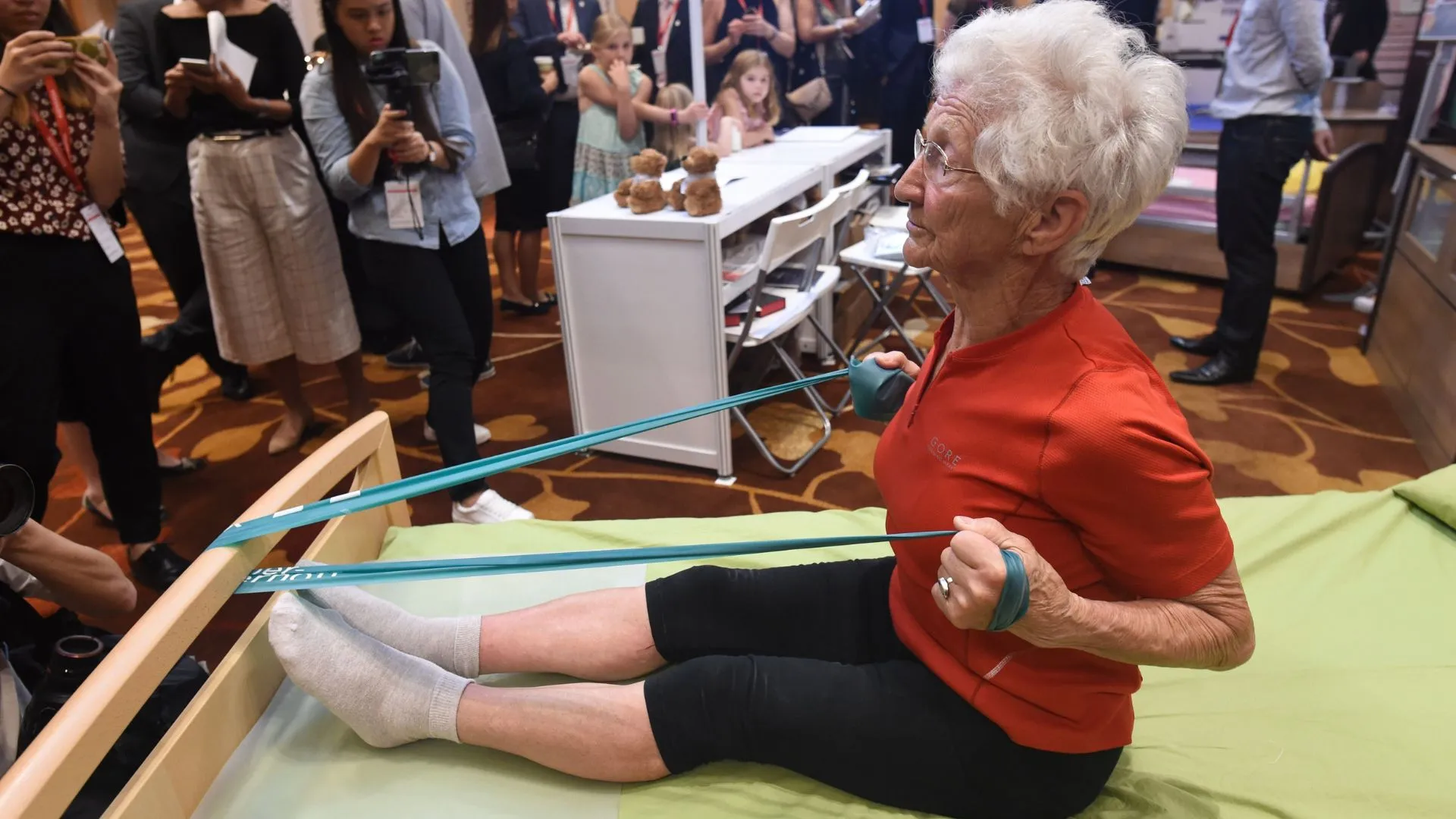
Scientists have long debated the greatest possible age of a person, with previous studies placing the limit at up to 150 years. But in the past 25 years, no one has surpassed the record for the world's oldest person, held by Jean Louise Calment, who died at age 122 in 1997.
"This has led people to argue that the maximum life span has been reached," David McCarthy, an assistant professor of risk management and insurance at the University of Georgia, told Live Science. In a new study, McCarthy and his colleagues say they've uncovered evidence that this longevity record will be broken within the next four decades. The team did not propose a maximum age that humans can live to, but rather, they used a mathematical model to project what mortality trends might look like in upcoming years.
However, not everyone agrees with the team's conclusions, experts told Live Science.
In the study, published March 29 in the journal PLOS One, the scientists analyzed mortality data from hundreds of millions of people in 19 countries who were born between the 1700s and the late 1900s, up to 1969. They tweaked an existing mathematical model to explore how the mortality rates among people ages 50 to 100 differed in people with different birth years. They then used this information to predict the ages that people may reach in the future.
Related: Scientists are hunting the secrets to extreme longevity in nuns...and jellyfish
In this model, mortality rates are assumed to increase exponentially beyond age 50 and then plateau at extremely old ages, McCarthy said. Such modeling can offer clues as to whether humans are nearing the maximum life span. If that were the case, you would expect any decreases in mortality rates in younger ages to be accompanied by mortality rates that increase more rapidly with age, to preserve the age limit, he explained.
The researchers found that this was generally the case among those born before 1900. However, the mortality rate trends in people born between 1910 and 1950 appear to be different. This group reached the old age-related plateau at older ages than the pre-1900s group had, and they didn't see sudden upticks in mortality at old ages to accompany decreases in mortality seen at younger ages. This finding hints we have not reached the maximum human life span, McCarthy said.
Get the world’s most fascinating discoveries delivered straight to your inbox.
"In most of the countries we examined, we project that the maximum age will rise dramatically in the future," McCarthy said. "This will lead to longevity records being broken in the next 40 years or so."
RELATED STORIES
For example, the model projects that the oldest Japanese woman born in 1919 or later has at least a 50% chance of living to age 122 or older. And the oldest Japanese woman born in 1940 or later has a 50% chance of surpassing age 130. (The model roughly covered the next 50 years, and didn't predict that anyone in any country would surpass age 150 in that time.)
However, the model has a major limitation: It does not account for the biology of aging. In other words, in predicting who has a decent chance of living past age 122, the model doesn't account for the fact that people's cells age over time and they become more prone to age-related diseases, like cancer. It also doesn't acknowledge how advances in medicine might extend human life span in the years to come.
"While we find this demographic analysis interesting, we have long believed that addressing basic questions about whether, when and how aging stops are best settled by research with large animal cohorts maintained under stable laboratory conditions," Michael Rose and Laurence Mueller, professors at the University of California, Irvine, who were not involved in the study, told Live Science in an email.
"The duration of life is at its heart a biological phenomenon, not a mathematical one," said Stuart Jay Olshanky, a professor of epidemiology and biostatistics at the University of Illinois Chicago who was not involved in the research.
McCarthy accepts these limitations, but "since the simple model we used fit historical mortality data extremely well," he said he thinks it can still offer useful insight into future mortality patterns.

Carissa Wong is a freelance reporter who holds a PhD in cancer immunology from Cardiff University, in collaboration with the University of Bristol. She was formerly a staff writer at New Scientist magazine covering health, environment, technology, nature and ancient life, and has also written for MailOnline.