













One of the brightest stars in the sky will 'blink out' on Dec. 12. Here's how to watch.
Betelgeuse, the most famous red supergiant star and one of the sky's brightest, will disappear for up to 12 seconds during an ultra-rare occultation by asteroid 319 Leona.

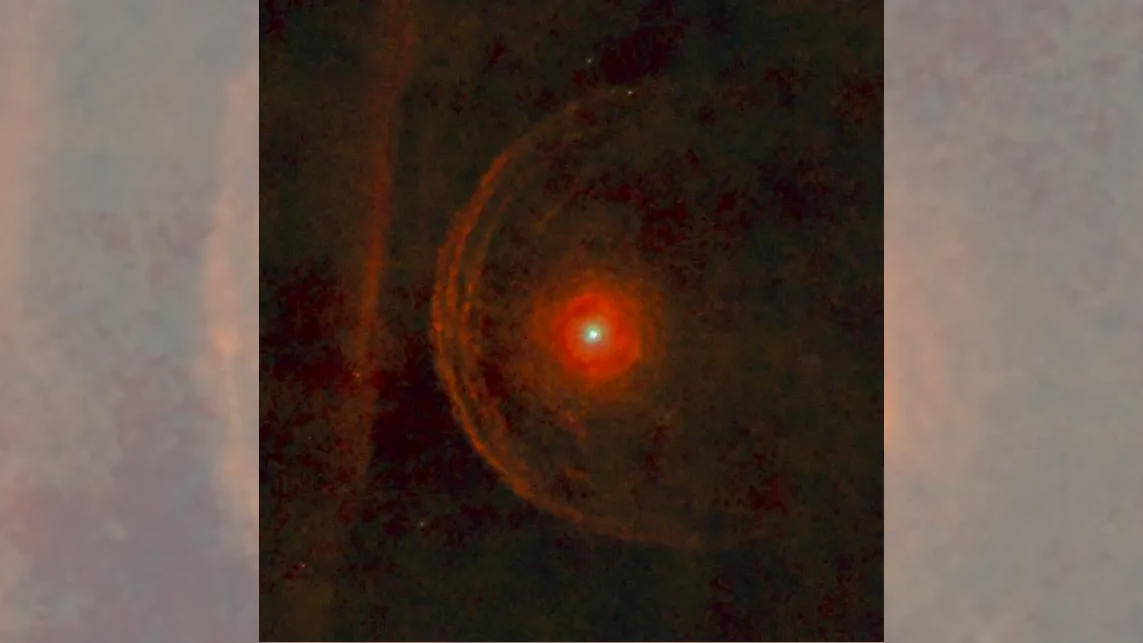
Next week, a rare celestial event will occur as an asteroid blocks the red supergiant star Betelgeuse in the constellation Orion.
Betelgeuse, usually the 10th-brightest star in the night sky, will briefly blink off Monday, Dec. 11 as the asteroid 319 Leona appears to pass in front of it from our point of view on Earth. The event, which will last only 12 seconds, will be a valuable opportunity for astronomers to create a map of the giant star's surface, which has been linked to its recent odd behavior.
It's highly unusual for one of the brightest stars in the night sky to be blocked, or "occulted," by an asteroid. Although the smaller asteroid may cause a "ring of fire" annular eclipse of Betelgeuse, a limited number of skywatchers will be in the right position to see it.
Related: Enormous planet discovered around tiny star could break our understanding of solar system formation
In addition to being a short event, the occultation will be visible only from a narrow path stretching from Asia to southern Europe, Florida and eastern Mexico. The International Occultation Timing Association has a special page dedicated to the event that includes a downloadable Google Earth file showing the complete path. Viewers within the path will be able to see the occultation without binoculars or a telescope, though both will help enhance the view of the rare event.
Anyone not in the path can watch a livestream of the event being hosted by The Virtual Telescope Project in Italy, which happens to fall within the path of the occultation. The livestream is set to begin at 8:00 p.m. EST on Dec. 11.
The occultation itself will occur around 8:17 p.m. EST, according to Sky & Telescope, though that time could shift by a few minutes as the orbit of 319 Leona is refined.
Get the world’s most fascinating discoveries delivered straight to your inbox.
RELATED STORIES
To find Betelegeuse from the Northern Hemisphere in December, look due east about two hours after sunset, and you'll see the three stars of Orion's Belt — Alnitak, Alnilam and Mintaka — rising into the sky. To their left, Betelgeuse will be level with Mintaka.
"These kind of occultations are very useful to constrain the shape of the asteroid involved," astrophysicist Gianluca Masi, director of The Virtual Telescope Project, said in a statement. The occultation may also allow scientists to map the surface of Betelgeuse. "We will be hopefully able to learn more about its large convective cells, which is driving its variable brightness," Masi added.

Jamie Carter is a Cardiff, U.K.-based freelance science journalist and a regular contributor to Live Science. He is the author of A Stargazing Program For Beginners and co-author of The Eclipse Effect, and leads international stargazing and eclipse-chasing tours. His work appears regularly in Space.com, Forbes, New Scientist, BBC Sky at Night, Sky & Telescope, and other major science and astronomy publications. He is also the editor of WhenIsTheNextEclipse.com.