An estimated 1 billion sea creatures were cooked to death across the Pacific Northwest during the region's record-breaking heat wave, a marine biologist said.
The shores of Kitsilano Beach in Vancouver, Canada, have been littered with tens of thousands of cooked and putrefying marine animals — including clams, mussels, sea stars and snails — after temperatures across British Columbia and the Pacific Northwest smashed records in late June, reaching a recorded high of 121.3 degrees Fahrenheit (49.6 degrees Celsius) roughly 96 miles (155 kilometers) northeast of Vancouver in the village of Lytton, British Columbia on June 29, according to Canada’s weather service, Environment Canada.
Chris Harley, a marine biologist at the University of British Columbia, was "stunned" to discover the mounds of dead animals after smelling the stench. Harley thinks that more than a billion seashore animals along the coastline of the Salish Sea — which stretches from British Columbia down to Washington — may have fried in the blistering temperatures.
Intertidal animals such as clams and mussels can only endure high temperatures for a short period of time, he said. But during the heat wave, those unlucky animals may have been exposed to the shoreline heat in the mid-afternoon when tides were lowest, trapping them on land for more than 6 hours.
"A mussel on the shore in some ways is like a toddler left in a car on a hot day," Harley told CBC news. "They are stuck there until the parent comes back, or in this case, the tide comes back in, and there's very little they can do. They're at the mercy of the environment. And on Saturday, Sunday, Monday [June 26-28], during the heatwave, it just got so hot that the mussels, there was nothing they could do."
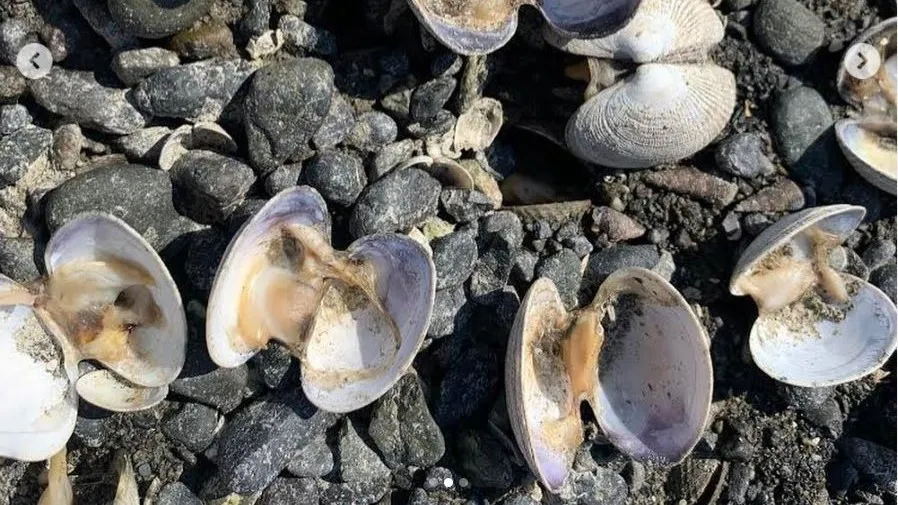
Shellfish were also baked alive in Washington's Hood Canal, a part of the Salish sea, with the Hama Hama company posting an image on Instagram and calling the situation "clamitous."
Sign up for the Live Science daily newsletter now
Get the world’s most fascinating discoveries delivered straight to your inbox.
Clam beds in Washington state's Hood Canal were littered with the cooked and putrefying mollusks.
(Image credit: Adam James/Hama Hama Oyster Company)
The mass death will have a temporary, but significant, effect on the water quality of the more than 4,000-mile-long (6440 km) Salish Sea coastline, according to Harley, as mussels and clams help to filter chemicals, such as excess nitrogen, and pathogens from seawater. Mussels are also in the middle of the food chain, so the die-off will have an impact on the coast's ability to provide nutrition for ducks and starfish, which eat the mollusks
Populations of the sea creatures should rebound in a year or two, but more frequent, and more severe, heat waves could have a more lasting impact on their numbers, Harley said.
The last heat wave to kill shellfish in this way was in 2019, when thousands of mussels were cooked to death in Bodega Bay, a bay north of San Francisco.
"If we don't like it, then we need to work harder to reduce emissions and take other measures to reduce the effects of climate change," Harley said.
Ben Turner is a U.K. based writer and editor at Live Science. He covers physics and astronomy, tech and climate change. He graduated from University College London with a degree in particle physics before training as a journalist. When he's not writing, Ben enjoys reading literature, playing the guitar and embarrassing himself with chess.